

Close Menu
AM ChronicleAM Chronicle
  • Content
    • News
    • Insights
    • Case Studies
    • AM Infocast
  • Focus Regions
    • India
    • Asia Pacific
    • Middle East
    • North America
    • Europe
  • Industries
    • Automotive
    • Aerospace
    • Defence
    • Energy
    • Construction
    • Healthcare
    • Tooling
    • Engineering
  • Training
  • Magazine
    • Digital Issues
  • Events
Facebook Instagram YouTube LinkedIn
  • About us
  • Media Kit
  • Contact us
Facebook Instagram YouTube LinkedIn
AM ChronicleAM Chronicle
  • Content
    1. News
    2. Insights
    3. Case Studies
    4. AM Infocast
    5. View All
    Lodestar3D Announces Exclusive Partnership with Prodways Group: Revolutionising Ceramic 3D Printing in India

    Lodestar3D Announces Exclusive Partnership with Prodways Group: Revolutionising Ceramic 3D Printing in India

    January 20, 2026
    Lodestar3D Boosts Indian Additive Manufacturing with Six TPM3D SLS System Installations

    Lodestar3D Installs Six TPM3D SLS System in Indian Companies

    December 27, 2025
    ARCI and Raghu Vamsi Machine Tools Sign MoU to Advance Additive Manufacturing and Surface Engineering

    ARCI and Raghu Vamsi Machine Tools Sign MoU to Advance Additive Manufacturing and Surface Engineering

    December 26, 2025
    Hang Yu, associate professor of materials science and engineering, with a miniaturized additive friction stir deposition machine used in his advanced manufacturing research. Photo by Peter Means for Virginia Tech.

    Scientists developed a 3D-printed smart composite that allows ceramics to flex under load

    December 25, 2025
    Gemini Generated Image eyzhd3eyzhd3eyzh

    Breaking the Thermal Barrier: 3D Printing Research on High-Performance Aluminum Alloys Innovates a New Class of Alloys

    December 17, 2025
    Making Milestones: 3D printing for a greener tomorrow

    Making Milestones: 3D printing for a greener tomorrow

    August 29, 2025
    Nestlé embraces technology and innovation in 3D printing

    Nestlé embraces technology and innovation in 3D printing

    August 29, 2025
    Pure copper and copper alloy (CuCrZr, CuCrNb, CuSn10) samples produced using ADDIREEN's green-laser powder bed fusion AM machines (Image courtesy: Addireen Technologies)

    Addireen: Pioneering Copper Printing in Metal Additive Manufacturing

    August 12, 2025
    Source: Formlabs

    Case Study: Eaton Corporation’s Strategic Transition to In-House 3D Printing for Tooling Applications

    August 29, 2025
    Revolutionizing Atherosclerosis Research with 3D-Bioprinted Brain Vessels

    Revolutionizing Atherosclerosis Research with 3D-Bioprinted Brain Vessels

    August 25, 2025
    Formlabs fuse 1+

    How Imaginarium Helped Kaash Studio Scale with the Right 3D Printing Technology

    April 12, 2025
    The Formlabs Fuse 1+ 30W

    Kaash Studio Optimized Service Bureau Operations with Formlabs 3D Printers- Case Study

    January 30, 2025
    Sustainable Production of Metal Powder for Additive Manufacturing

    Sustainable Production of Metal Powder for Additive Manufacturing with Bruce Bradshaw

    February 15, 2024
    Meeting Evolving Customer Demands in the Additive Manufacturing Industry with Tyler Reid

    Meeting Evolving Customer Demands in the Additive Manufacturing Industry with Tyler Reid

    February 9, 2024
    Innovation is at the heart of AMUG with Diana Kalisz

    Innovation is at the heart of AMUG with Diana Kalisz

    March 7, 2023
    3D Printing Workshops at AMUG with Edward Graham

    3D Printing Workshops at AMUG with Edward Graham

    March 7, 2023
    Lodestar3D Announces Exclusive Partnership with Prodways Group: Revolutionising Ceramic 3D Printing in India

    Lodestar3D Announces Exclusive Partnership with Prodways Group: Revolutionising Ceramic 3D Printing in India

    January 20, 2026
    Lodestar3D Boosts Indian Additive Manufacturing with Six TPM3D SLS System Installations

    Lodestar3D Installs Six TPM3D SLS System in Indian Companies

    December 27, 2025
    ARCI and Raghu Vamsi Machine Tools Sign MoU to Advance Additive Manufacturing and Surface Engineering

    ARCI and Raghu Vamsi Machine Tools Sign MoU to Advance Additive Manufacturing and Surface Engineering

    December 26, 2025
    Hang Yu, associate professor of materials science and engineering, with a miniaturized additive friction stir deposition machine used in his advanced manufacturing research. Photo by Peter Means for Virginia Tech.

    Scientists developed a 3D-printed smart composite that allows ceramics to flex under load

    December 25, 2025
  • Focus Regions
    • India
    • Asia Pacific
    • Middle East
    • North America
    • Europe
  • Industries
    • Automotive
    • Aerospace
    • Defence
    • Energy
    • Construction
    • Healthcare
    • Tooling
    • Engineering
  • Training
  • Magazine
    • Digital Issues
  • Events
Subscribe
AM ChronicleAM Chronicle
Home » News

Using Additive Manufacturing To Detect Counterfeited Parts

News By AM Chronicle EditorDecember 21, 20224 Mins Read
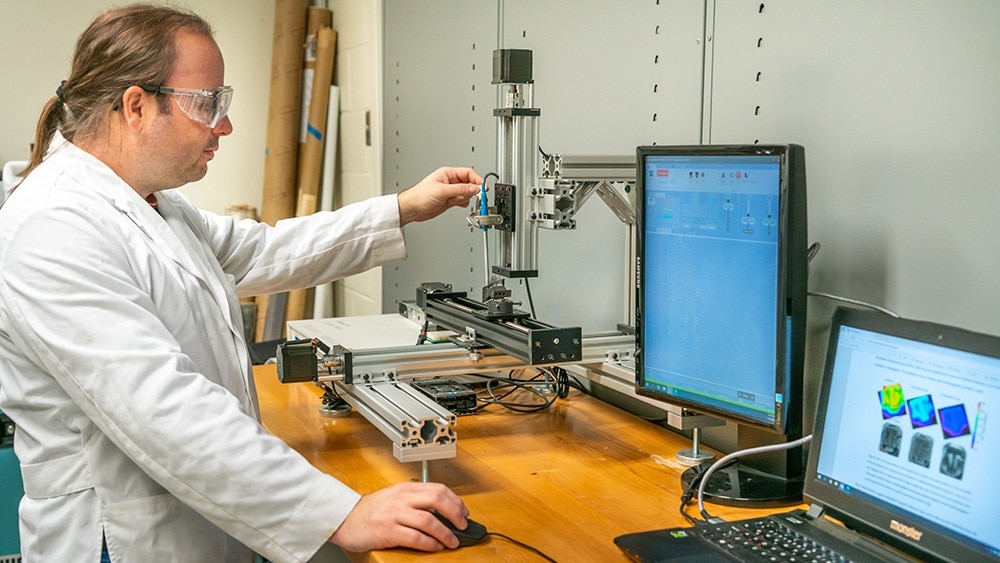
MSEN news additive maufacturing demo Dec2022
Daniel Salas demonstrates how the hidden magnetic tag can store a cache of information within an item.
LinkedIn Twitter Facebook WhatsApp Pinterest Email Copy Link

Texas A&M Researchers are applying metal additive manufacturing techniques to embed a hidden cache of information within products to help combat counterfeited goods.

Ensuring manufactured goods and components have not been copied and replaced illegally by counterfeited goods is a high-priority concern of the manufacturing and defense industries in the U.S. and around the world.

A potential solution would hold wide-reaching impacts and implications in various areas ranging from enhancing biomedical implants to protecting national defense assets.

Texas A&M University researchers have developed a method of imprinting a hidden magnetic tag, encoded with authentication information, within manufactured hardware during the part fabrication process. The revolutionary process holds the potential to expose counterfeit goods more easily by replacing physical tags — such as barcodes or quick response (QR) codes — with these hidden magnetic tags, which serve as permanent and unique identifiers.

The project, titled “Embedded Information in Additively Manufactured Metals via Composition Gradients for Anti-Counterfeiting and Supply Chain Traceability,” is a faculty partner project supported by the SecureAmerica Institute. It includes researchers from the Department of Materials Science and Engineering and the J. Mike Walker ’66 Department of Mechanical Engineering at Texas A&M. The team recently published its research in the journal Additive Manufacturing.

The faculty investigators on the project include Ibrahim Karaman, Chevron Professor I and department head of the materials science and engineering department; Raymundo Arroyave, professor of materials science and engineering and Segers Family Dean’s Excellence Professor; and Richard Malak, associate professor of mechanical engineering and Gulf Oil/Thomas A. Dietz Career Development Professor. In addition to the faculty, Daniel Salas Mula, a researcher with the Texas A&M Engineering Experiment Station, and doctoral student Deniz Ebeperi — both members of Karaman’s research group — have worked on the project. The team has also collaborated with Jitesh Panchal, professor of mechanical engineering at Purdue University.

Ensuring security and reliable authentication in manufacturing is a critical national concern, with the U.S. investing billions of dollars in manufacturing. Without such a method readily available, it can be nearly impossible to differentiate an authentic part or component from its counterfeit copy.

“The issue is that when I come up with an idea, device or part, it is very easy for others to copy and even fabricate it much more cheaply — though maybe at a lower quality,” Karaman said. “Sometimes they even put the same brand name, so how do you make sure that item isn’t yours? (The embedded magnetic tag) gives us an opportunity and a new tool to make sure that we can protect our defense and manufacturing industries.”
MSEN news additive maufacturing equipment Dec2022 350x197 1
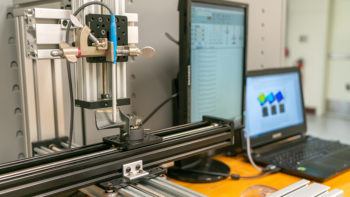
The team’s custom three-axis magnetic sensor is capable of mapping the surface and revealing the regions where an embedded magnetic tag is accessible.

The team is implementing metal additive manufacturing techniques to accomplish its goal of successfully embedding readable magnetic tags into metal parts without compromising on performance or longevity. Researchers used 3D printing to embed these magnetic tags below the surface into nonmagnetic steel hardware.

Other applications for this method include traceability, quality control and more, largely depending on the industry in which it is used.

Once embedded into a nonmagnetic item, the magnetic tag is readable using a magnetic sensor device — such as a smartphone — by scanning near the correct location on the product, allowing the designated information to be accessed by the user.

While other methods exist for imprinting information, they primarily require sophisticated and costly equipment that introduces a barrier to real-world implementation.

“Different approaches have been used to try to locally change the properties of the metals during the manufacturing process to be able to codify information within the part,” said Salas Mula. “This is the first time that magnetic properties of the material are being used in this way to introduce information within a nonmagnetic part, specifically for the 3D printing of metals.”

Ebeperi said that to map the magnetic reading of the part, the team created a custom three-axis magnetic sensor capable of mapping the surface and revealing the regions where the embedded magnetic tag was accessible.

While the system is more secure than a physical tag or code located on the exterior of an item, the team is still working to improve the complexity of the method’s security.

As the project continues, Karaman said the next steps include developing a more secure method of reading the information, possibly through the implementation of a physical “dual-authentication” requiring the user to apply a specific treatment or stimulus to unlock access to the magnetic tag.

Subscribe to AM Chronicle Newsletter to stay connected:  https://bit.ly/3fBZ1mP 

Follow us on LinkedIn: https://bit.ly/3IjhrFq 

Visit for more interesting content on additive manufacturing: https://amchronicle.com

Original Source

3d printing additive manufacturing magnet Metal Additive Manufacturing Quality Control research Texas A&M USA
AM Chronicle Editor

NAMIC GLOBAL AM SUMMIT 2025
LATEST FROM AM
Lodestar3D Announces Exclusive Partnership with Prodways Group: Revolutionising Ceramic 3D Printing in India News

Lodestar3D Announces Exclusive Partnership with Prodways Group: Revolutionising Ceramic 3D Printing in India

January 20, 20262 Mins Read
Lodestar3D Boosts Indian Additive Manufacturing with Six TPM3D SLS System Installations News

Lodestar3D Installs Six TPM3D SLS System in Indian Companies

December 27, 20252 Mins Read
ARCI and Raghu Vamsi Machine Tools Sign MoU to Advance Additive Manufacturing and Surface Engineering News

ARCI and Raghu Vamsi Machine Tools Sign MoU to Advance Additive Manufacturing and Surface Engineering

December 26, 20252 Mins Read

CONNECT WITH US

  • 126 A, Dhuruwadi, A. V. Nagvekar Marg, Prabhadevi, Mumbai 400025
  • [email protected]
  • +91 022 24306319
Facebook Instagram YouTube LinkedIn

Newsletter

Subscribe to the AM Chronicle mailer to receive latest tech updates and insights from global industry experts.

SUBSCRIBE NOW

Quick Links

  • News
  • Insights
  • Case Studies
  • AM Training
  • AM Infocast
  • AM Magazine
  • Events

Media

  • Advertise with us
  • Sponsored Articles
  • Media Kit

Events

CNT Expositions & Services
© 2025 CNT Expositions & Services LLP.
  • Privacy Policy
  • Cookie Policy

Type above and press Enter to search. Press Esc to cancel.


0 / 75