

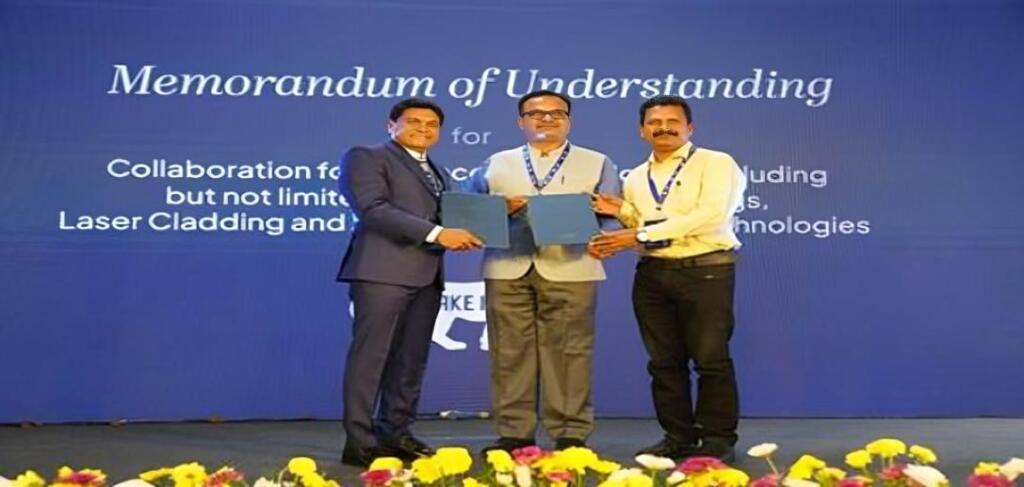
The International Advanced Research Centre for Powder Metallurgy and New Materials (ARCI) has signed a Memorandum of Understanding (MoU) with Raghu Vamsi Machine Tools Pvt. Limited. This strategic partnership aims to bridge the gap between laboratory research and industrial application in the fields of additive manufacturing and surface engineering.
Strengthening the GOCO Model
The collaboration will be executed under the Government Owned Company Operated (GOCO) model. This framework allows Raghu Vamsi, a prominent private player in the aerospace and defense sectors, to leverage ARCI’s world-class research infrastructure and specialized facilities to develop market-ready technological solutions.
Core Focus Areas
The partnership focuses on high-performance engineering applications, specifically targeting the aerospace, defense, and energy sectors. Key technical domains include:
- Additive Manufacturing: Development of 3D-printed metal components and high-performance alloys.
- Surface Engineering: Advancing laser-based processes and precision treatment for critical components.
- Precision Machining: High-accuracy processing for strategic engineering needs.
- Advanced Materials: Processing and testing materials designed to withstand extreme environments.
Bridging Lab to Market
The MoU establishes a structured framework for joint R&D, technology demonstration, and intellectual property (IP) creation. By combining ARCI’s deep scientific expertise with Raghu Vamsi’s industrial manufacturing capabilities, the partnership seeks to accelerate the transition of innovations from the “lab scale” to the “factory floor.”
Strategic Impact
ARCI, an autonomous R&D institution under the Department of Science and Technology (DST), and the Hyderabad-based Raghu Vamsi Group aim to create a scalable ecosystem for indigenous technology. This move is expected to enhance India’s global competitiveness and reduce dependence on imported high-performance engineering components.
The agreement remains flexible, allowing for expansion into emerging technological domains as the needs of India’s strategic sectors evolve.
Original Source