

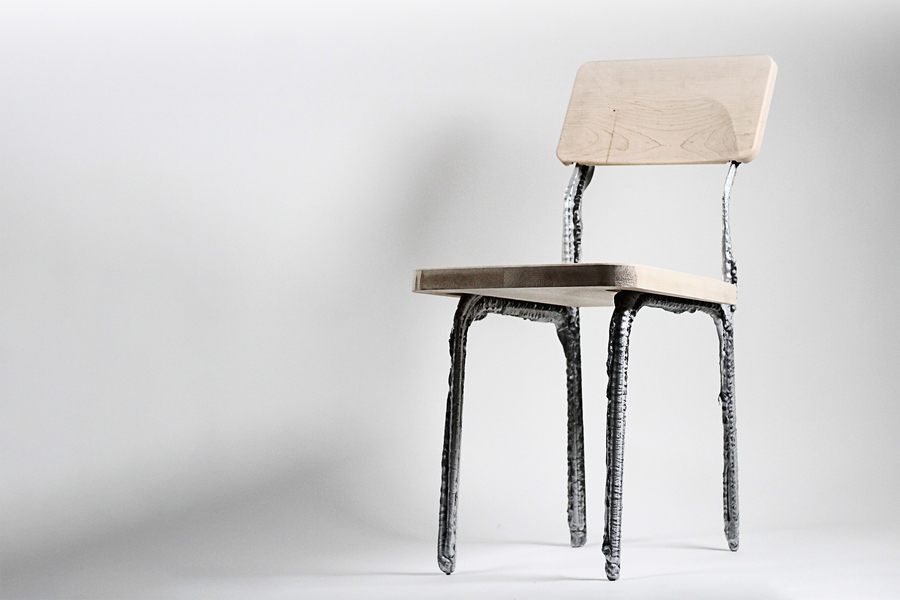
MIT researchers have developed an additive manufacturing technique that can print rapidly with liquid metal, producing large-scale parts like table legs and chair frames in a matter of minutes.
Their technique, called liquid metal printing (LMP), involves depositing molten aluminum along a predefined path into a bed of tiny glass beads. The aluminum quickly hardens into a 3D structure.
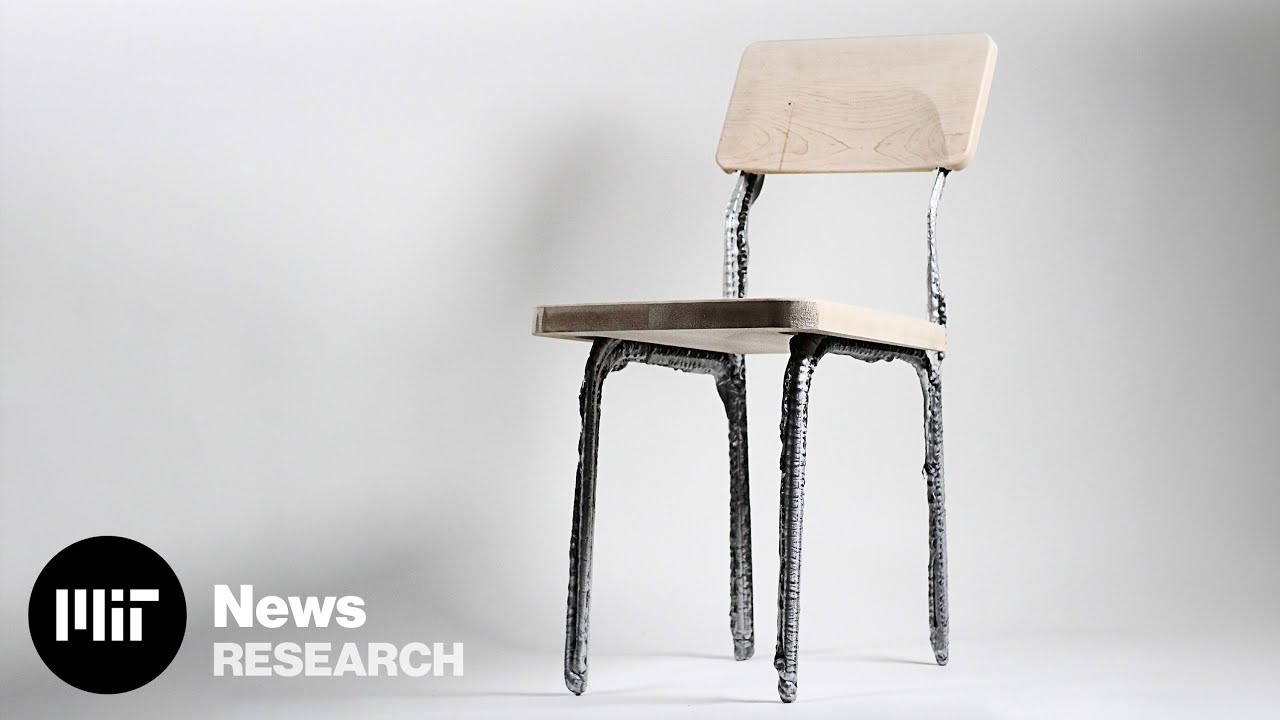
The researchers say LMP is at least 10 times faster than a comparable metal additive manufacturing process, and the procedure to heat and melt the metal is more efficient than some other methods.
The technique does sacrifice resolution for speed and scale. While it can print components that are larger than those typically made with slower additive techniques, and at a lower cost, it cannot achieve high resolutions.
For instance, parts produced with LMP would be suitable for some applications in architecture, construction, and industrial design, where components of larger structures often don’t require extremely fine details. It could also be utilized effectively for rapid prototyping with recycled or scrap metal.
In a recent study, the researchers demonstrated the procedure by printing aluminum frames and parts for tables and chairs which were strong enough to withstand postprint machining. They showed how components made with LMP could be combined with high-resolution processes and additional materials to create functional furniture.
“This is a completely different direction in how we think about metal manufacturing that has some huge advantages. It has downsides, too. But most of our built world — the things around us like tables, chairs, and buildings — doesn’t need extremely high resolution. Speed and scale, and also repeatability and energy consumption, are all important metrics,” says Skylar Tibbits, associate professor in the Department of Architecture and co-director of the Self-Assembly Lab, who is senior author of a paper introducing LMP.
Tibbits is joined on the paper by lead author Zain Karsan SM ’23, who is now a PhD student at ETH Zurich; as well as Kimball Kaiser SM ’22 and Jared Laucks, a research scientist and lab co-director. The research was presented at the Association for Computer Aided Design in Architecture Conference and recently published in the association’s proceedings.
Significant speedup
One method for printing with metals that is common in construction and architecture, called wire arc additive manufacturing (WAAM), is able to produce large, low-resolution structures, but these can be susceptible to cracking and warping because some portions must be remelted during the printing process.
LMP, on the other hand, keeps the material molten throughout the process, avoiding some of the structural issues caused by remelting.
Drawing on the group’s previous work on rapid liquid printing with rubber, the researchers built a machine that melts aluminum, holds the molten metal, and deposits it through a nozzle at high speeds. Large-scale parts can be printed in just a few seconds, and then the molten aluminum cools in several minutes.
“Our process rate is really high, but it is also very difficult to control. It is more or less like opening a faucet. You have a big volume of material to melt, which takes some time, but once you get that to melt, it is just like opening a tap. That enables us to print these geometries very quickly,” Karsan explains.
The team chose aluminum because it is commonly used in construction and can be recycled cheaply and efficiently.
Bread loaf-sized pieces of aluminum are deposited into an electric furnace, “which is basically like a scaled-up toaster,” Karsan adds. Metal coils inside the furnace heat the metal to 700 degrees Celsius, slightly above aluminum’s 660-degree melting point.
The aluminum is held at a high temperature in a graphite crucible, and then molten material is gravity-fed through a ceramic nozzle into a print bed along a preset path. They found that the larger the amount of aluminum they could melt, the faster the printer can go.
“Molten aluminum will destroy just about everything in its path. We started with stainless steel nozzles and then moved to titanium before we ended up with ceramic. But even ceramic nozzles can clog because the heating is not always entirely uniform in the nozzle tip,” Karsan says.
By injecting the molten material directly into a granular substance, the researchers don’t need to print supports to hold the aluminum structure as it takes shape.
Perfecting the process
They experimented with a number of materials to fill the print bed, including graphite powders and salt, before selecting 100-micron glass beads. The tiny glass beads, which can withstand the extremely high temperature of molten aluminum, act as a neutral suspension so the metal can cool quickly.
“The glass beads are so fine that they feel like silk in your hand. The powder is so small that it doesn’t really change the surface characteristics of the printed object,” Tibbits says.
The amount of molten material held in the crucible, the depth of the print bed, and the size and shape of the nozzle have the biggest impacts on the geometry of the final object.
For instance, parts of the object with larger diameters are printed first, since the amount of aluminum the nozzle dispenses tapers off as the crucible empties. Changing the depth of the nozzle alters the thickness of the metal structure.
To aid in the LMP process, the researchers developed a numerical model to estimate the amount of material that will be deposited into the print bed at a given time.
Because the nozzle pushes into the glass bead powder, the researchers can’t watch the molten aluminum as it is deposited, so they needed a way to simulate what should be going on at certain points in the printing process, Tibbits explains.
They used LMP to rapidly produce aluminum frames with variable thicknesses, which were durable enough to withstand machining processes like milling and boring. They demonstrated a combination of LMP and these post-processing techniques to make chairs and a table composed of lower-resolution, rapidly printed aluminum parts and other components, like wood pieces.
Moving forward, the researchers want to keep iterating on the machine so they can enable consistent heating in the nozzle to prevent material from sticking, and also achieve better control over the flow of molten material. But larger nozzle diameters can lead to irregular prints, so there are still technical challenges to overcome.
“If we could make this machine something that people could actually use to melt down recycled aluminum and print parts, that would be a game-changer in metal manufacturing. Right now, it is not reliable enough to do that, but that’s the goal,” Tibbits says.
“At Emeco, we come from the world of very analog manufacturing, so seeing the liquid metal printing creating nuanced geometries with the potential for fully structural parts was really compelling,” says Jaye Buchbinder, who leads business development for the furniture company Emeco and was not involved with this work. “The liquid metal printing really walks the line in terms of ability to produce metal parts in custom geometries while maintaining quick turnaround that you don’t normally get in other printing or forming technologies. There is definitely potential for the technology to revolutionize the way metal printing and metal forming are currently handled.”
Additional researchers who worked on this project include Kimball Kaiser, Jeremy Bilotti, Bjorn Sparrman, Schendy Kernizan, and Maria Esteban Casanas.
This research was funded, in part, by Aisin Group, Amada Global, and Emeco.
Subscribe to AM Chronicle Newsletter to stay connected: https://bit.ly/3fBZ1mP
Follow us on LinkedIn: https://bit.ly/3IjhrFq
Visit for more interesting content on additive manufacturing: https://amchronicle.com