


This article series by AM Chronicle focusses on the various aspects of Composite Additive Manufacturing with this first part focussing on the introduction and landscape
Additive manufacturing has evolved considerably since its inception, it has transformed from being just a prototyping technology to now being used in wide range of domains and production applications owing to the contribution from researchers and the industry adopters. The aim of this article is to introduce the reader to Composite Additive Manufacturing and provide a glimpse into its current landscape.
Composites are materials made by combining two or more materials with notably different chemical or physical properties. The result composite material is usually exhibits significantly higher mechanical properties than the principal materials. Some of the standard composites used in the industry are carbon fiber, glass fiber, Kevlar, and natural fiber-reinforced material. Today, composites are used in various industry sectors such as aerospace, automotive, sports equipment, machine tools, and robotics.
Manufacturing and designing composite material is technologically challenging. One of the most critical challenges is the manufacturing process of the composites. Several researchers have shown that misalignment of even a degree in the laminate (sheet of composite) can significantly degrade mechanical properties. In addition to this, the design process of composites is complex and requires a skilled workforce. Additionally, designing new composites and manufacturing novel composites with the desired performance is critical.
Composite Additive Manufacturing provides a solution to this manufacturing challenges and enables to manufacturing the fully functionally composite component layer by layer, which has mechanical and chemical properties close to the traditionally manufactured composite.
Earliest Works on Composite Additive Manufacturing
The earliest industrial development in composite additive manufacturing was a photosensitive resin made by a French company “Optoform.” The company mixed ceramics and composite materials into photosensitive resin. Post-curing, the photosensitive resin had properties of composite materials. Later the company Optoform was acquired by 3D Systems. After which, DSM Somos introduced new resins in April 2005. The resin was using a nanocomposite material with high‐elongation material and low‐durometer material.
During this era of 2012-2015, various companies evolved around the technology of hybrid additive manufacturing and composite additive manufacturing. Suppose we categorize the composite 3D printing landscape based upon the foundation years of some of the significant companies. In that case, it can be distinguished that most of the companies were formed during 2017-2021. This fact helps to identify that composite additive manufacturing technology is yet under the development phase, as it is not mature. Additionally, when these companies and their technology mature more, we will likely see further development in composite additive manufacturing.
Recent Composite Additive Manufacturing Methods Used in Industry
Based on the evolutions of this technology various companies and researchers have approached this process with different techniques. The commonly used approaches can be divided into five types: in-situ impregnation, co-extrusion with towpreg matrix, towpreg extrusion, in-situ consolidation and inline impregnation.
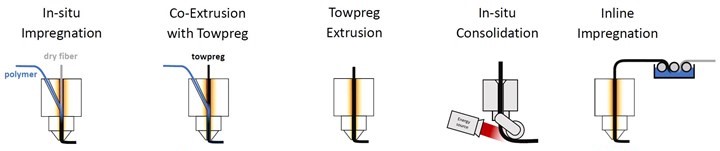
Source: Alexander Matschinski, Virtual Symposium on AFP and AM, TU Munich, Chair of Carbon Composites (LCC), Sep. 2020.
Dry fiber is introduced to the print bed through a nozzle in the in-suit impregnation. After which, the epoxy and the resin are added at an elevated temperature.
In co-extrusion with the towpreg matrix, the tape is added to the print bed through the nozzle. Materials are added to the matrix tape through an attachment in the nozzle.
The towpreg extrusion is one of the most straightforward processes of composite additive manufacturing as only a single nozzle is used to print the composite materials. The process works like the fused deposition modeling method and can be added to traditional FDM printers.
In-situ consolidation is also known as the automated fiber placement process. The fiber is placed through the nozzle and heated with added support (laser, heat source, heated epoxy).
The inline impregnation process integrates the advantages of both traditional manufacturing and additive manufacturing. In this process, the composite fibers are prepared through conventional manufacturing and printed on the print bed through a nozzle.
Few other approaches are also seeing traction in recent times and we have attempted to provide a snapshot on a few of them.
Robot-based fiber reinforced plastic additive manufacturing is a robotic arm used to print the material. The advantages of robotic additive manufacturing over cartesian additive manufacturing are robotic additive manufacturing does not require the print bed to print the material, and added printing axis (from 3 axes to 5 axes) can be added easefully. Moreover, the process of robotic additive manufacturing is considered to overcome several technological challenges of cartesian-based additive manufacturing. In addition to this, the robotic arm can be attached with diverse types of nozzles and help integrate different composite additive manufacturing methods, which is challenging with cartesian-based additive manufacturing.
Additive Molding is a process that automates the additive manufacturing and moulding of complex items made of continuous 3D-aligned fibres (such as carbon and glass), thermoplastics, and components.
Fiber Placement is an automated composites manufacturing technique that involves heating and compacting pre-impregnated synthetic resin non-metallic fibres on often complex tooling mandrels.
Fiber patch placement (FPP) technology is a robotic manufacturing process used to create fibre composite items.
TFP, or Tailored Fiber Placement, is a novel and extremely disruptive technology for composite additive manufacturing that uses a stitching approach to place fibrous materials in specified routes.
To make the material printable, the fibre strands in conventional fiber-filled filament are cut very short. The most evident disadvantage is that there is limited overlap between the fibres and no fibres that span adjacent layers. As a result, parts produced with fiber-filled materials are frequently just slightly stronger or stiffer than ordinary 3D printed ones.
3D printing using continuous fibre is exactly what it sounds like. Instead of embedding millions of half-millimeter-long strands of fibre into the filament during manufacturing, a spool of fibre is utilised to embed very long strands of fibre into items as they are printed. Because it better resembles the production process of traditional carbon fibre products, where long strands of fibre are piled on top of one another in a resin, continuous fibre 3D printing gives far higher strength and stiffness.
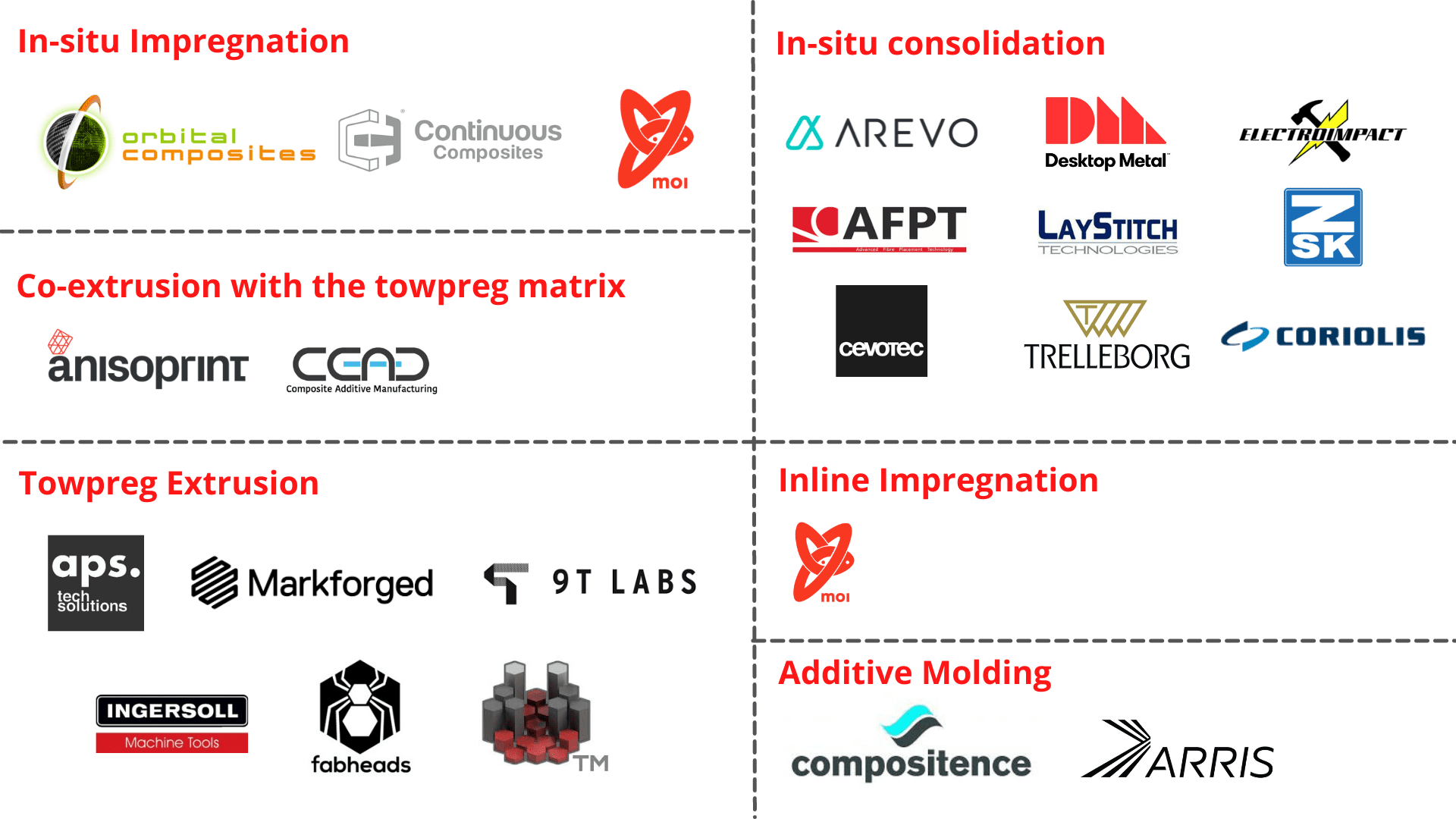
The following infographic and table summarises key companies in the Composite Additive Manufacting Landscape in the knowledge of the author and AM Chronicle.:
| Sno | Company | Technology Specialization |
| 1 | Arris Composites | Additive Molding |
| 2 | Ingersoll Machine Tools | Towpreg Extrusion |
| 5 | Markforged | Towpreg Extrusion |
| 6 | Anisoprint | Co-extrusion with the towpreg matrix |
| 9 | CEAD Group | Co-extrusion with the towpreg matrix |
| 10 | Continuous Composites | In-situ impregnation |
| 11 | 9T lab | Towpreg Extrusion |
| 12 | APS Technological Solutions | Towpreg Extrusion |
| 14 | Fabheads Automation | Towpreg Extrusion |
| 15 | MOI Composites | In-situ impregnation |
| 16 | Orbital Composites | n-situ impregnation |
| 20 | Mantis Composites | Towpreg Extrusion |
| 21 | AREVO | In-situ consolidation |
| 22 | Desktop Metal | In-situ consolidation |
| 23 | Electroimpact | In-situ consolidation |
| 24 | AFPT Composites | In-situ consolidation |
| 25 | Trelleborg | In-situ consolidation |
| 26 | Compositence | Additive Molding |
| 27 | Coriolis | In-situ consolidation |
| 28 | Cevotoc | In-situ consolidation |
| 29 | Laystitch | In-situ consolidation |
| 30 | ZSK Machines | In-situ consolidation |
References:
Hegab, H.A., 2016. Design for additive manufacturing of composite materials and potential alloys: a review. Manufacturing Review, 3, p.11.
Parandoush, P. and Lin, D., 2017. A review on additive manufacturing of polymer-fiber composites. Composite Structures, 182, pp.36-53.
Wohlers, T. and Gornet, T., 2014. History of additive manufacturing. Wohlers report, 24(2014), p.118.