


For decades, aluminum has been the “golden child” of the automotive and aerospace sectors—lightweight, abundant, and strong. However, it has always harbored a fundamental weakness: heat. At temperatures exceeding 200°C, conventional aluminum alloys lose their structural integrity, forcing engineers to rely on heavier steel or nickel-based superalloys for engine components and turbines.
A study recently published in Nature Communications (Takata et al., 2025) and highlighted by Interesting Engineering reveals how researchers at Nagoya University have used the unique physics of 3D printing to create a new class of aluminum alloys that remain strong and flexible even at 300°C.
The Secret: Designing for the “Melt Pool”
Traditional metallurgy is governed by equilibrium—slow cooling processes where atoms settle into predictable, stable structures. The researchers, led by Professor Naoki Takata, realized that Laser Powder Bed Fusion (L-PBF)—a standard metal 3D printing technique—operates under “non-equilibrium” conditions.
The laser melts metal powder in a fraction of a second, followed by “extreme cooling rates” that solidify the material almost instantly. This rapid cooling traps elements like iron, manganese, and titanium in metastable arrangements that are impossible to achieve through traditional casting.
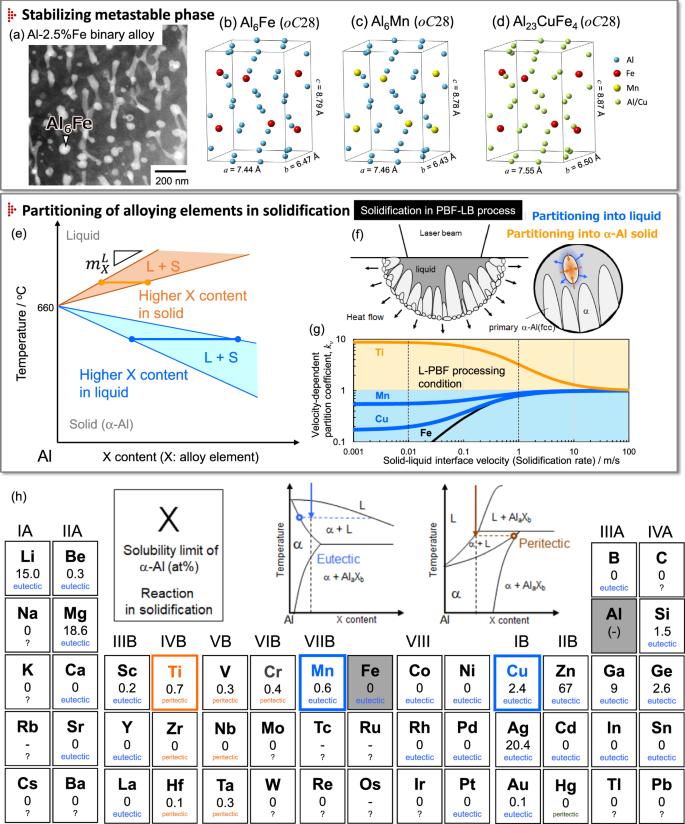
Design concept of Al-Fe multi-elemental systems suitable for the PBF-LB process., Credits: Takata et al., 2025
The Composition: Al-Fe-Mn-Ti
The team developed a systematic framework to predict which elements would best stabilize these 3D-printed microstructures. The standout performer is an alloy composed of Aluminum, Iron, Manganese, and Titanium (Al-Fe-Mn-Ti).
Key features of this new material include:
- High-Temperature Stability: While standard 3D-printed aluminum often softens at high heat, this alloy maintains its strength at 300°C.
- Exceptional Ductility: Unlike many high-strength alloys that become brittle, the Al-Fe-Mn-Ti variant retains flexibility (room-temperature ductility), making it less prone to cracking during the printing process.
- Sustainability & Recyclability: The alloy uses low-cost, earth-abundant elements rather than expensive rare earths, ensuring it fits within a circular manufacturing economy.
Why This Matters for AM Professionals
For the AM industry, this isn’t just about a new powder on the shelf; it is about the validation of 3D printing as a primary material-creation tool.
“The extreme cooling rates in laser powder bed fusion change the fundamental rules of metallurgy,” noted Professor Takata. This research provides a “design manual” for creating metals specifically for 3D printing, rather than trying to force-fit traditional alloys into a printer.
Impact on Industry: Lighter Engines, Lower Emissions
The implications for the “Efficient Engine” are massive. By replacing heavier components in compressor rotors, turbine parts, and internal combustion housings with these heat-resistant aluminum alloys, manufacturers can:
- Reduce Vehicle Mass: Lighter parts mean better fuel economy and extended range for electric vehicles (EVs).
- Increase Efficiency: Higher operating temperatures generally correlate to better thermodynamic efficiency in engines.
- Simplify Supply Chains: The ability to print complex, heat-stable parts on-demand reduces the need for expensive casting molds and complex sub-assemblies.
The Road Ahead
As the aerospace and automotive industries push for Net-Zero targets, the demand for “light but hot” materials will only grow. The work coming out of Nagoya University suggests that the future of these industries isn’t just shaped by the printers we use, but by the very atoms we trap within their lasers.
For the AM community, the message is clear: the next generation of high-performance materials won’t be found in a furnace, but in the rapid-fire cooling of the melt pool.
*** References:
- Takata, N., et al. (2025). “Design of high-performance sustainable aluminum alloy series for laser additive manufacturing.” Nature Communications.
- Interesting Engineering: “Strong aluminum alloys for efficient engines.”