

Close Menu
AM ChronicleAM Chronicle
  • Content
    • News
    • Insights
    • Case Studies
    • AM Infocast
  • Focus Regions
    • India
    • Asia Pacific
    • Middle East
    • North America
    • Europe
  • Industries
    • Automotive
    • Aerospace
    • Defence
    • Energy
    • Construction
    • Healthcare
    • Tooling
    • Engineering
  • Training
  • Magazine
    • Digital Issues
  • Events
Facebook Instagram YouTube LinkedIn
  • About us
  • Media Kit
  • Contact us
Facebook Instagram YouTube LinkedIn
AM ChronicleAM Chronicle
  • Content
    1. News
    2. Insights
    3. Case Studies
    4. AM Infocast
    5. View All
    Bahrain’s First Advanced Additive Manufacturing Hub Launched

    Bahrain Launches First Advanced Additive Manufacturing Hub in Partnership with Roboze

    December 12, 2025
    Airbus Now 3D Printing Over 25,000 Flight-Ready Plastic Parts Annually

    Airbus Now 3D Printing Over 25,000 Flight-Ready Plastic Parts Annually

    December 12, 2025
    Caracol and RusselSmith Sign a Strategic Partnership to Drive Advanced Manufacturing in West Africa

    Caracol and RusselSmith Sign a Strategic Partnership to Drive Advanced Manufacturing in West Africa

    October 3, 2025
    NAMI and Lockheed Martin Collaborate for Additive Manufacturing Conversion Project

    NAMI and Lockheed Martin Collaborate for Additive Manufacturing Conversion Project 

    September 16, 2025
    Making Milestones: 3D printing for a greener tomorrow

    Making Milestones: 3D printing for a greener tomorrow

    August 29, 2025
    Nestlé embraces technology and innovation in 3D printing

    Nestlé embraces technology and innovation in 3D printing

    August 29, 2025
    Pure copper and copper alloy (CuCrZr, CuCrNb, CuSn10) samples produced using ADDIREEN's green-laser powder bed fusion AM machines (Image courtesy: Addireen Technologies)

    Addireen: Pioneering Copper Printing in Metal Additive Manufacturing

    August 12, 2025
    Digital Twin Integration in Additive Manufacturing Systems: Revolutionizing Design, Production, and Lifecycle Management

    Digital Twin Integration in Additive Manufacturing Systems: Revolutionizing Design, Production, and Lifecycle Management

    July 4, 2025
    Source: Formlabs

    Case Study: Eaton Corporation’s Strategic Transition to In-House 3D Printing for Tooling Applications

    August 29, 2025
    Revolutionizing Atherosclerosis Research with 3D-Bioprinted Brain Vessels

    Revolutionizing Atherosclerosis Research with 3D-Bioprinted Brain Vessels

    August 25, 2025
    Formlabs fuse 1+

    How Imaginarium Helped Kaash Studio Scale with the Right 3D Printing Technology

    April 12, 2025
    The Formlabs Fuse 1+ 30W

    Kaash Studio Optimized Service Bureau Operations with Formlabs 3D Printers- Case Study

    January 30, 2025
    Sustainable Production of Metal Powder for Additive Manufacturing

    Sustainable Production of Metal Powder for Additive Manufacturing with Bruce Bradshaw

    February 15, 2024
    Meeting Evolving Customer Demands in the Additive Manufacturing Industry with Tyler Reid

    Meeting Evolving Customer Demands in the Additive Manufacturing Industry with Tyler Reid

    February 9, 2024
    Innovation is at the heart of AMUG with Diana Kalisz

    Innovation is at the heart of AMUG with Diana Kalisz

    March 7, 2023
    3D Printing Workshops at AMUG with Edward Graham

    3D Printing Workshops at AMUG with Edward Graham

    March 7, 2023
    Bahrain’s First Advanced Additive Manufacturing Hub Launched

    Bahrain Launches First Advanced Additive Manufacturing Hub in Partnership with Roboze

    December 12, 2025
    Airbus Now 3D Printing Over 25,000 Flight-Ready Plastic Parts Annually

    Airbus Now 3D Printing Over 25,000 Flight-Ready Plastic Parts Annually

    December 12, 2025
    Ms. Larissa Smith, Director, Advanced Manufacturing, DRPM, Maritime Industrial Base Program, U.S. Navy, and Mr. Ken Jeanos, VP, Materials and Supply Chain, General Dynamics Electric Boat, are joined by Lincoln Electric leadership and its Additive Solutions team to commemorate the ribbon cutting that marks the investment of four SculptPrint™ 1500 additive manufacturing cells to support the production of critical submarine components.

    U.S. Navy’s Maritime Industrial Base Program, General Dynamics Electric Boat, and Lincoln Electric Advance Additive Manufacturing to Strengthen Submarine Production

    October 3, 2025
    Caracol and RusselSmith Sign a Strategic Partnership to Drive Advanced Manufacturing in West Africa

    Caracol and RusselSmith Sign a Strategic Partnership to Drive Advanced Manufacturing in West Africa

    October 3, 2025
  • Focus Regions
    • India
    • Asia Pacific
    • Middle East
    • North America
    • Europe
  • Industries
    • Automotive
    • Aerospace
    • Defence
    • Energy
    • Construction
    • Healthcare
    • Tooling
    • Engineering
  • Training
  • Magazine
    • Digital Issues
  • Events
Subscribe
AM ChronicleAM Chronicle
Home » News

Scientists develop method of 3D printing glass objects with “unique optical, electrical and chemical properties”

News By AM Chronicle EditorJune 14, 20224 Mins Read
Screenshot 2022 06 13 at 11.20.19 1024x715 1
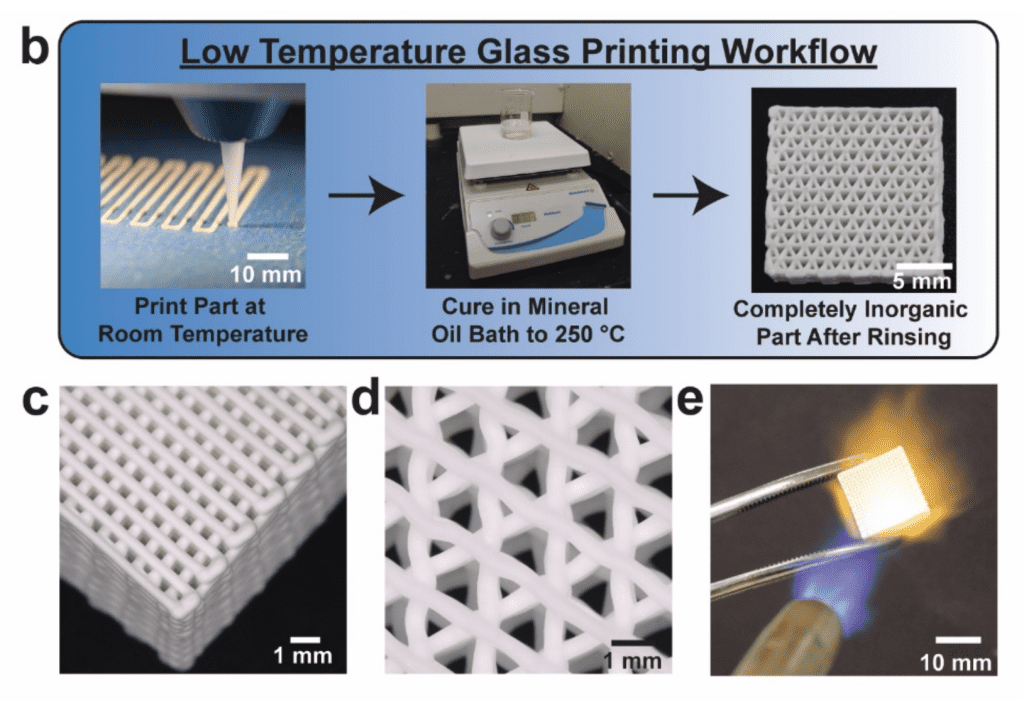
The MIT scientists’ low-temperature glass 3D printing workflow. Image via the MIT Lincoln Laboratory.
LinkedIn Twitter Facebook WhatsApp Pinterest Email Copy Link

Researchers at the US Department of Defense-backed MIT Lincoln Laboratory have come up with a novel low-temperature approach to 3D printing glass objects.

More from the News 

Unlike conventional glass 3D printing and post-processing, which involves exposing parts to temperatures of 1,000 °C or more, the scientists’ involves layering a custom, highly-filled ink, that’s curable at 250°C. Due to the accessibility of their material’s ingredients and the simplicity of their process, the team believe it could “facilitate the widespread production of glass objects,” with unique characteristics.

“We have shown a modular system that can be tuned to print a wide variety of inorganic glasses with embedded functional nanomaterials (dielectric, metallic and optical),” explain the scientists in their paper. “We envision this versatile materials platform, when combined with multi-material additive manufacturing, will enable the fabrication of a wide variety of robust microsystems.”

Glass 3D printing’s thermal problem? 

Though glass 3D printing remains at a relatively early stage of development, the technology is beginning to show potential as a means of realizing objects with more complex geometries than those possible via traditional glass processing.

Using multi-material techniques, for instance, researchers are increasingly able to create parts like optical lenses and microfluidic devices with higher mechanical strength and graded refractive indices. Given the sub-millimeter features it’s now possible to achieve using 3D printing, the technology’s also showing potential as a means of producing glass objects capable of enhancing devices’ functionalities.

That being said, such parts, when created via stereolithography, two-photon lithography or direct ink writing (DIW), are subjected to high temperatures, whether this be in deposition or during debinding. These steps tend to yield stable glass structures, but also require the use of specialized refractory gear, and they can be incompatible with thermally-sensitive materials, limiting users’ choice of feedstock.

“Emerging techniques for additively generating inorganic structures have the potential to disrupt the ceramic and glass industries,” say the team in their paper. “Glass offers advantages over other additive manufacturing materials, such as improved biocompatibility and enhanced thermal stability. However, current methods for producing glass require elevated temperatures to produce a completely inorganic part.”
Screenshot 2022 06 13 at 11.19.49 1024x633 1
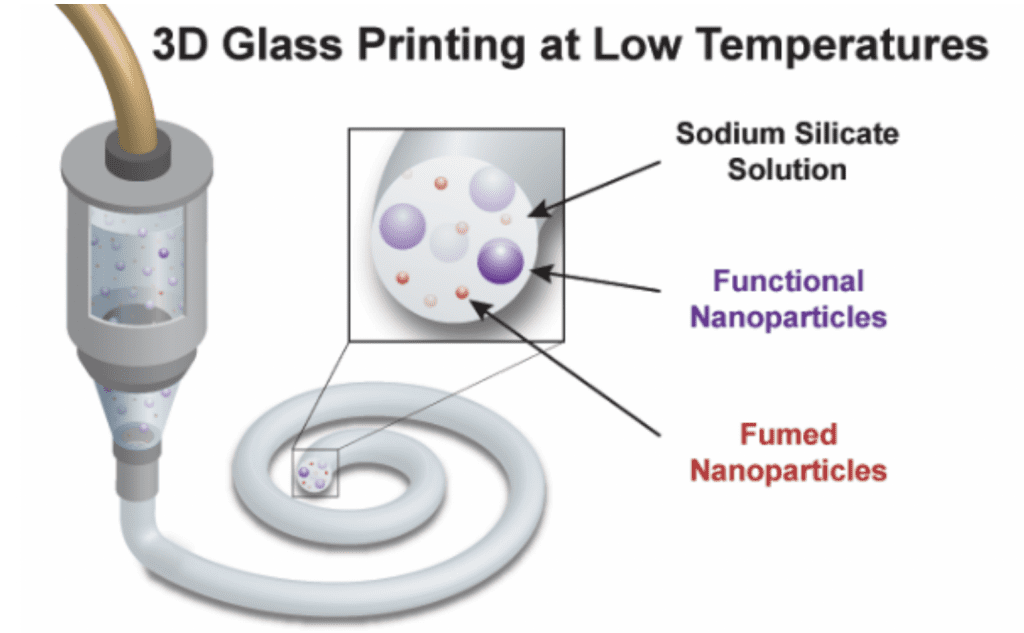
The highly-filled nanocomposite behind the scientists’ approach. Image via the MIT Lincoln Laboratory.


The MIT low-temp alternative  

Central to the researchers’ alternative, is a custom nano-composite they’ve developed. Composed of functional nanoparticles embedded in a sodium silicate solution, as well as silver particles in its conductive iteration, the ink is printable at much lower temperatures than normal. Once formulated, this material was put into action by the team via a DIW-equipped 3-axis Aerotech gantry system.

After creating some basic shapes and structures, the scientists found that mounting barrels of structural and silver inks onto the machine’s two independent z-axes, enabled the creation of capacitors and resistors. These parts, following curing in a mineral oil bath, showed a high level of stability, though the MIT team admit that they didn’t quite have the same optical clarity as sintered parts.

Through later imaging, the researchers also found they’d been able to achieve different trace lengths with their prototype resistors, and tweak the permittivity levels of their material to change the capacity of capacitors produced, with those made from barium, strontium and titanium oxide having the highest power factor.

According to the team, their experiments show that their process can be tailored to produce a “broad range of electronic materials and integrated microsystems.” Moving forwards, the scientists plan to focus on improving the optical clarity of parts produced, and providing them with graded properties, as a way of further broadening their potential applications.

“The major advantage of this technique lies in its simplicity,” conclude the team in their paper. “We believe this silicate-based strategy will facilitate the production of custom microfluidic chemical reactors with much wider chemical and thermal compatibilities than are currently available. Furthermore, we predict these materials will allow for the creation of novel, high power radio frequency devices.”

MITLL 265456 2C 0
MIT’s Lincoln Laboratory. Photo via MIT.


Putting glass 3D printing into practise 

Glass 3D printing may not have been commercialized just yet, but the technology continues to find new applications, many of which have focused on photonics. As one of the leading start-ups working in this emerging field, Glassomer has come up with a 3D printing silica nanocomposite of its own, which has since been 3D printed at room temperature into glass parts, the thickness of a human hair.

The researchers’ findings are detailed in their paper titled “Low Temperature Additive Manufacturing of Glass,” co-authored by Bradley Duncan, Devon Beck, Paul Miller, Ryan Benz and Melissa Smith.

Subscribe to AM Chronicle Newsletter to stay connected:  https://bit.ly/3fBZ1mP 

Follow us on LinkedIn: https://bit.ly/3IjhrFq 

Visit for more interesting content on additive manufacturing: https://amchronicle.com/

For more information and case studies on metal additive manufacturing register for metal additive manufacturing symposium : https://amchronicle.com/metal-additive-manufacturing/

Original Source

3d printing 3d printing glass 3D printing research additive manufacturing Aerotech glass MIT Lincoln Laboratory US Department of Defense USA
AM Chronicle Editor

NAMIC GLOBAL AM SUMMIT 2025
LATEST FROM AM
Bahrain’s First Advanced Additive Manufacturing Hub Launched Middle East

Bahrain Launches First Advanced Additive Manufacturing Hub in Partnership with Roboze

December 12, 20252 Mins Read
Airbus Now 3D Printing Over 25,000 Flight-Ready Plastic Parts Annually News

Airbus Now 3D Printing Over 25,000 Flight-Ready Plastic Parts Annually

December 12, 20252 Mins Read
Ms. Larissa Smith, Director, Advanced Manufacturing, DRPM, Maritime Industrial Base Program, U.S. Navy, and Mr. Ken Jeanos, VP, Materials and Supply Chain, General Dynamics Electric Boat, are joined by Lincoln Electric leadership and its Additive Solutions team to commemorate the ribbon cutting that marks the investment of four SculptPrint™ 1500 additive manufacturing cells to support the production of critical submarine components. Uncategorized

U.S. Navy’s Maritime Industrial Base Program, General Dynamics Electric Boat, and Lincoln Electric Advance Additive Manufacturing to Strengthen Submarine Production

October 3, 20252 Mins Read

CONNECT WITH US

  • 126 A, Dhuruwadi, A. V. Nagvekar Marg, Prabhadevi, Mumbai 400025
  • [email protected]
  • +91 022 24306319
Facebook Instagram YouTube LinkedIn

Newsletter

Subscribe to the AM Chronicle mailer to receive latest tech updates and insights from global industry experts.

SUBSCRIBE NOW

Quick Links

  • News
  • Insights
  • Case Studies
  • AM Training
  • AM Infocast
  • AM Magazine
  • Events

Media

  • Advertise with us
  • Sponsored Articles
  • Media Kit

Events

CNT Expositions & Services
© 2025 CNT Expositions & Services LLP.
  • Privacy Policy
  • Cookie Policy

Type above and press Enter to search. Press Esc to cancel.


0 / 75