

Close Menu
AM ChronicleAM Chronicle
  • Content
    • News
    • Insights
    • Case Studies
    • AM Infocast
  • Focus Regions
    • India
    • Asia Pacific
    • Middle East
    • North America
    • Europe
  • Industries
    • Automotive
    • Aerospace
    • Defence
    • Energy
    • Construction
    • Healthcare
    • Tooling
    • Engineering
  • Training
  • Magazine
    • Digital Issues
  • Events
Facebook Instagram YouTube LinkedIn
  • About us
  • Media Kit
  • Contact us
Facebook Instagram YouTube LinkedIn
AM ChronicleAM Chronicle
  • Content
    1. News
    2. Insights
    3. Case Studies
    4. AM Infocast
    5. View All
    Caracol and RusselSmith Sign a Strategic Partnership to Drive Advanced Manufacturing in West Africa

    Caracol and RusselSmith Sign a Strategic Partnership to Drive Advanced Manufacturing in West Africa

    October 3, 2025
    NAMI and Lockheed Martin Collaborate for Additive Manufacturing Conversion Project

    NAMI and Lockheed Martin Collaborate for Additive Manufacturing Conversion Project 

    September 16, 2025
    LEGO Introduces First Mass-Produced 3D Printed Piece in New Holiday Train Set

    LEGO Introduces First Mass-Produced 3D Printed Piece in New Holiday Train Set

    September 15, 2025
    Boeing Revolutionizes Satellite Production with 3D-Printed Solar Arrays

    Boeing Revolutionizes Satellite Production with 3D-Printed Solar Arrays

    September 15, 2025
    Making Milestones: 3D printing for a greener tomorrow

    Making Milestones: 3D printing for a greener tomorrow

    August 29, 2025
    Nestlé embraces technology and innovation in 3D printing

    Nestlé embraces technology and innovation in 3D printing

    August 29, 2025
    Pure copper and copper alloy (CuCrZr, CuCrNb, CuSn10) samples produced using ADDIREEN's green-laser powder bed fusion AM machines (Image courtesy: Addireen Technologies)

    Addireen: Pioneering Copper Printing in Metal Additive Manufacturing

    August 12, 2025
    Digital Twin Integration in Additive Manufacturing Systems: Revolutionizing Design, Production, and Lifecycle Management

    Digital Twin Integration in Additive Manufacturing Systems: Revolutionizing Design, Production, and Lifecycle Management

    July 4, 2025
    Source: Formlabs

    Case Study: Eaton Corporation’s Strategic Transition to In-House 3D Printing for Tooling Applications

    August 29, 2025
    Revolutionizing Atherosclerosis Research with 3D-Bioprinted Brain Vessels

    Revolutionizing Atherosclerosis Research with 3D-Bioprinted Brain Vessels

    August 25, 2025
    Formlabs fuse 1+

    How Imaginarium Helped Kaash Studio Scale with the Right 3D Printing Technology

    April 12, 2025
    The Formlabs Fuse 1+ 30W

    Kaash Studio Optimized Service Bureau Operations with Formlabs 3D Printers- Case Study

    January 30, 2025
    Sustainable Production of Metal Powder for Additive Manufacturing

    Sustainable Production of Metal Powder for Additive Manufacturing with Bruce Bradshaw

    February 15, 2024
    Meeting Evolving Customer Demands in the Additive Manufacturing Industry with Tyler Reid

    Meeting Evolving Customer Demands in the Additive Manufacturing Industry with Tyler Reid

    February 9, 2024
    Innovation is at the heart of AMUG with Diana Kalisz

    Innovation is at the heart of AMUG with Diana Kalisz

    March 7, 2023
    3D Printing Workshops at AMUG with Edward Graham

    3D Printing Workshops at AMUG with Edward Graham

    March 7, 2023
    Ms. Larissa Smith, Director, Advanced Manufacturing, DRPM, Maritime Industrial Base Program, U.S. Navy, and Mr. Ken Jeanos, VP, Materials and Supply Chain, General Dynamics Electric Boat, are joined by Lincoln Electric leadership and its Additive Solutions team to commemorate the ribbon cutting that marks the investment of four SculptPrint™ 1500 additive manufacturing cells to support the production of critical submarine components.

    U.S. Navy’s Maritime Industrial Base Program, General Dynamics Electric Boat, and Lincoln Electric Advance Additive Manufacturing to Strengthen Submarine Production

    October 3, 2025
    Caracol and RusselSmith Sign a Strategic Partnership to Drive Advanced Manufacturing in West Africa

    Caracol and RusselSmith Sign a Strategic Partnership to Drive Advanced Manufacturing in West Africa

    October 3, 2025

    Book References

    September 20, 2025
    NAMI and Lockheed Martin Collaborate for Additive Manufacturing Conversion Project

    NAMI and Lockheed Martin Collaborate for Additive Manufacturing Conversion Project 

    September 16, 2025
  • Focus Regions
    • India
    • Asia Pacific
    • Middle East
    • North America
    • Europe
  • Industries
    • Automotive
    • Aerospace
    • Defence
    • Energy
    • Construction
    • Healthcare
    • Tooling
    • Engineering
  • Training
  • Magazine
    • Digital Issues
  • Events
Subscribe
AM ChronicleAM Chronicle
Home » News

Additive Manufacturing Could Turn the Tides for Marine Energy Technologies—Here Is How

News Press Release By AM Chronicle EditorMay 6, 20246 Mins Read
20240503 additive manufacturing spar
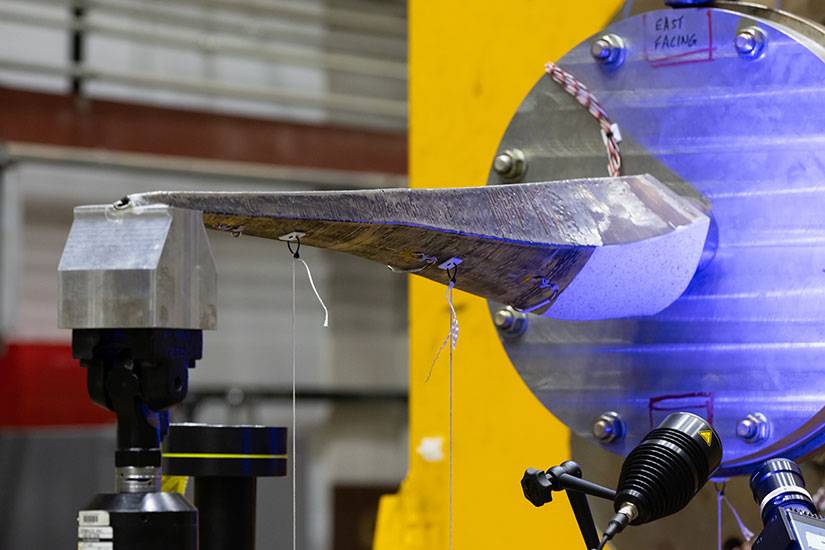
The 3D-printed stainless steel tidal turbine spar undergoes testing at NREL. Photo by Joe DelNero, NREL
LinkedIn Twitter Facebook WhatsApp Pinterest Email Copy Link

Milk and cookies. Peanut butter and jelly. Macaroni and cheese. All delightfully perfect pairs. Researchers at the National Renewable Energy Laboratory (NREL) discovered another promising pair: marine energy and additive manufacturing.

Since February 2022, researchers at NREL and the Pacific Northwest National Laboratory have been exploring how additive manufacturing could complement marine energy technologies. More commonly known as 3D printing, additive manufacturing is a process that uses thin layers of material (like polymers, metals, ceramics, or others) to create a physical object from a three-dimensional model. A model is created in a digital file, which transfers to the printer.

“In the very beginning, we quickly figured out that typical plastic additive manufacturing processes wouldn’t produce strong enough components to handle ocean forces,” said Paul Murdy, a mechanical engineer at NREL and principal investigator for the marine energy additive manufacturing study. “It became apparent that it would be impossible to design this structure without using metals.”

With support from the U.S. Department of Energy’s Water Power Technologies Office to advance foundational research and development for the Powering the Blue Economy™ initiative, the NREL team has been analyzing materials and printing methods for components that make up tidal turbine blades. Through their research, experts have determined that stainless steel (a corrosion-resistant material) and laser metal deposition (an additive manufacturing method) are the most promising options for fabricating tidal turbine spars.

But what exactly is a turbine spar? A spar acts as a backbone for the turbine blade, holding the structure in place—which means that it is a critical, load-bearing component. And these components need to be extra-durable for the ocean environment.

“We’ve opened a really unique design space through 3D printing,” Murdy said. “This project has demonstrated that additive manufacturing has the potential to produce very strong, stiff structures that will be good for marine energy.”

Additive manufacturing could also address many of the challenges that marine energy faces, like lengthy manufacturing timelines and high costs. For example, additive manufacturing allows experts to design components with unique details—material can be added and easily taken away in different places without adding manufacturing steps or impacting timelines. Because of this, developers can test several unique designs within a much shorter time frame and with a significantly lower investment.

Advancing Practical and Accessible Technologies

Miguel González-Montijo, a graduate intern at NREL who is earning a doctorate in civil engineering, designed the turbine’s spar.

“I was interested in the spar geometry and wanted to ensure that the spar’s shape, size, and geometric intricacies matched an existing marine turbine blade design,” González-Montijo said.
20240503 additive manufacturing fullwidth
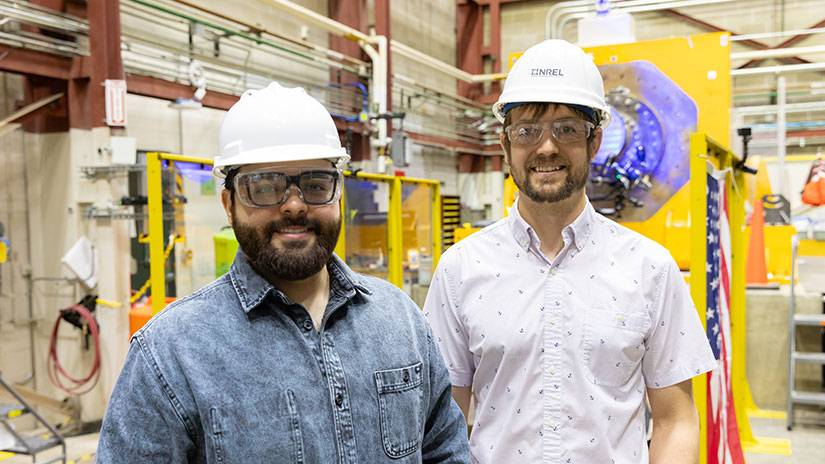
Miguel González-Montijo (left) and Paul Murdy (right) prepare the tidal turbine spar for lab testing. Photo by Joe DelNero, NREL

By designing a spar that can be used in existing tidal turbine technologies, the team hopes to enable rapid prototyping of marine energy devices. Having more prototypes would allow for more testing and design iterations, which would help researchers identify the most promising technologies for blue economy sectors, such as aquaculture or microgrids in coastal communities.

“For specific communities in particular places, marine energy could be a game changer,” González-Montijo said. “For example, my home, Puerto Rico, could benefit from an upgraded energy grid that incorporates renewable energy technologies like marine hydrokinetic energy. These technologies could help many small towns build energy resilience and independence while delivering locally sourced, renewable power.”

Using a combination of computer-aided design files (or CAD files) and state-of-the-art 3D-printing software, parts can be uniquely and specifically designed for different technologies and then printed to fit perfectly within the system. This technique not only allows researchers to plug and play, investigating which parts work best for certain scenarios, but it also makes marine energy much more accessible through widely used design tools (such as standard CAD software).

Say, for example, a coastal community installs a wave energy converter to help power a microgrid, but a component wears out. With access to a 3D printer, the local team maintaining the device could import a CAD file, print the part, and replace it. In other words, additive manufacturing could help build resilience and energy security in coastal regions by meeting a community’s needs quickly. Rather than depending on supply chains or driving long distances to get replacement parts, additive manufacturing could give communities much more control over their energy infrastructure.

Reaching the Testing Point

The NREL research team is now testing their 3D-printed spar to validate the design and the tools used to model and fabricate the spar.

“Structural validation is critical to ensuring that the spar will react to real-life forces in the way that our models predict,” Murdy said. “It also helps us understand how the novel additive manufacturing process differs from conventional steel manufacturing techniques and how we can account for it in future designs.”

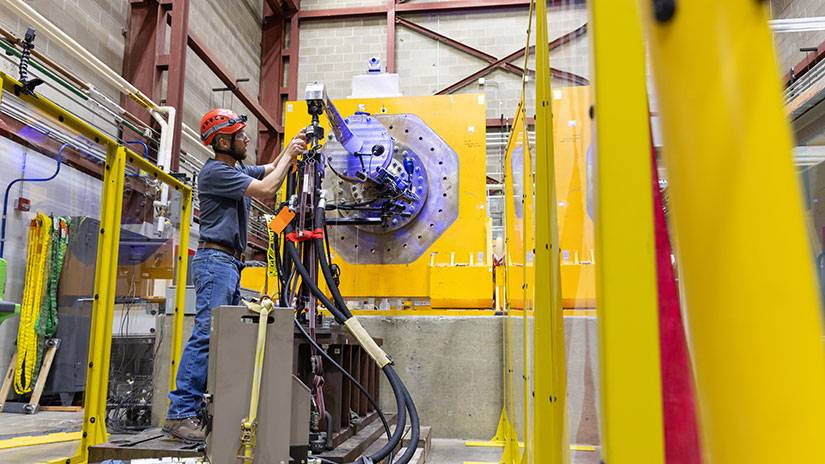
The team plans to perform load testing by gradually increasing the amount of force and weight on the spar—maxing out at 1,900 pounds, which is 50% more than what the spar is designed to handle. Researchers will also perform fatigue testing (i.e., repeating stresses and strains) to understand how long the spar would hold up to the intensities of the ocean environment.
20240503 additive manufacturing spar testing
The team sets up the tidal turbine on a hydraulic actuator (a system that uses hydraulic power to generate linear, rotary, or oscillatory motion). Photo by Joe DelNero, NREL

“This test is the final piece for our research and will bring the project full circle,” Murdy said. “We’ve been able to take an all-encompassing approach with this project: From theoretical modeling to materialized testing, we’ve exercised all of our capabilities.”

The NREL team relied on Ai-Build to fabricate the spar itself (which took about a week to print). However, this project proved that having the capability to 3D-print these types of components would benefit the laboratory’s marine energy and water power research at large. Soon, NREL researchers will have access to a 3D printer that can fabricate similar components using metal and other innovative materials.

Once testing is complete, the NREL team will synthesize the results and continue iterating on the spar design. They will also investigate other areas where this method can further marine energy technologies.

Original Source

3d printing additive manufacturing
AM Chronicle Editor

NAMIC GLOBAL AM SUMMIT 2025
LATEST FROM AM
Ms. Larissa Smith, Director, Advanced Manufacturing, DRPM, Maritime Industrial Base Program, U.S. Navy, and Mr. Ken Jeanos, VP, Materials and Supply Chain, General Dynamics Electric Boat, are joined by Lincoln Electric leadership and its Additive Solutions team to commemorate the ribbon cutting that marks the investment of four SculptPrint™ 1500 additive manufacturing cells to support the production of critical submarine components. Uncategorized

U.S. Navy’s Maritime Industrial Base Program, General Dynamics Electric Boat, and Lincoln Electric Advance Additive Manufacturing to Strengthen Submarine Production

October 3, 20252 Mins Read
Caracol and RusselSmith Sign a Strategic Partnership to Drive Advanced Manufacturing in West Africa News

Caracol and RusselSmith Sign a Strategic Partnership to Drive Advanced Manufacturing in West Africa

October 3, 20252 Mins Read

Book References

September 20, 20257 Mins Read

CONNECT WITH US

  • 126 A, Dhuruwadi, A. V. Nagvekar Marg, Prabhadevi, Mumbai 400025
  • [email protected]
  • +91 022 24306319
Facebook Instagram YouTube LinkedIn

Newsletter

Subscribe to the AM Chronicle mailer to receive latest tech updates and insights from global industry experts.

SUBSCRIBE NOW

Quick Links

  • News
  • Insights
  • Case Studies
  • AM Training
  • AM Infocast
  • AM Magazine
  • Events

Media

  • Advertise with us
  • Sponsored Articles
  • Media Kit

Events

CNT Expositions & Services
© 2025 CNT Expositions & Services LLP.
  • Privacy Policy
  • Cookie Policy

Type above and press Enter to search. Press Esc to cancel.


0 / 75