


Close Menu
AM ChronicleAM Chronicle
  • Content
    • News
    • Insights
    • Case Studies
    • AM Infocast
  • Focus Regions
    • India
    • Asia Pacific
    • Middle East
    • North America
    • Europe
  • Industries
    • Automotive
    • Aerospace
    • Defence
    • Energy
    • Construction
    • Healthcare
    • Tooling
    • Engineering
  • Training
  • Magazine
    • Digital Issues
  • Events
Facebook Instagram YouTube LinkedIn
  • About us
  • Media Kit
  • Contact us
Facebook Instagram YouTube LinkedIn
AM ChronicleAM Chronicle
  • Content
    1. News
    2. Insights
    3. Case Studies
    4. AM Infocast
    5. View All
    Lodestar3D Announces Exclusive Partnership with Prodways Group: Revolutionising Ceramic 3D Printing in India

    Lodestar3D Announces Exclusive Partnership with Prodways Group: Revolutionising Ceramic 3D Printing in India

    January 20, 2026
    Lodestar3D Boosts Indian Additive Manufacturing with Six TPM3D SLS System Installations

    Lodestar3D Installs Six TPM3D SLS System in Indian Companies

    December 27, 2025
    ARCI and Raghu Vamsi Machine Tools Sign MoU to Advance Additive Manufacturing and Surface Engineering

    ARCI and Raghu Vamsi Machine Tools Sign MoU to Advance Additive Manufacturing and Surface Engineering

    December 26, 2025
    Hang Yu, associate professor of materials science and engineering, with a miniaturized additive friction stir deposition machine used in his advanced manufacturing research. Photo by Peter Means for Virginia Tech.

    Scientists developed a 3D-printed smart composite that allows ceramics to flex under load

    December 25, 2025
    Gemini Generated Image eyzhd3eyzhd3eyzh

    Breaking the Thermal Barrier: 3D Printing Research on High-Performance Aluminum Alloys Innovates a New Class of Alloys

    December 17, 2025
    Making Milestones: 3D printing for a greener tomorrow

    Making Milestones: 3D printing for a greener tomorrow

    August 29, 2025
    Nestlé embraces technology and innovation in 3D printing

    Nestlé embraces technology and innovation in 3D printing

    August 29, 2025
    Pure copper and copper alloy (CuCrZr, CuCrNb, CuSn10) samples produced using ADDIREEN's green-laser powder bed fusion AM machines (Image courtesy: Addireen Technologies)

    Addireen: Pioneering Copper Printing in Metal Additive Manufacturing

    August 12, 2025
    Source: Formlabs

    Case Study: Eaton Corporation’s Strategic Transition to In-House 3D Printing for Tooling Applications

    August 29, 2025
    Revolutionizing Atherosclerosis Research with 3D-Bioprinted Brain Vessels

    Revolutionizing Atherosclerosis Research with 3D-Bioprinted Brain Vessels

    August 25, 2025
    Formlabs fuse 1+

    How Imaginarium Helped Kaash Studio Scale with the Right 3D Printing Technology

    April 12, 2025
    The Formlabs Fuse 1+ 30W

    Kaash Studio Optimized Service Bureau Operations with Formlabs 3D Printers- Case Study

    January 30, 2025
    Sustainable Production of Metal Powder for Additive Manufacturing

    Sustainable Production of Metal Powder for Additive Manufacturing with Bruce Bradshaw

    February 15, 2024
    Meeting Evolving Customer Demands in the Additive Manufacturing Industry with Tyler Reid

    Meeting Evolving Customer Demands in the Additive Manufacturing Industry with Tyler Reid

    February 9, 2024
    Innovation is at the heart of AMUG with Diana Kalisz

    Innovation is at the heart of AMUG with Diana Kalisz

    March 7, 2023
    3D Printing Workshops at AMUG with Edward Graham

    3D Printing Workshops at AMUG with Edward Graham

    March 7, 2023
    Lodestar3D Announces Exclusive Partnership with Prodways Group: Revolutionising Ceramic 3D Printing in India

    Lodestar3D Announces Exclusive Partnership with Prodways Group: Revolutionising Ceramic 3D Printing in India

    January 20, 2026
    Lodestar3D Boosts Indian Additive Manufacturing with Six TPM3D SLS System Installations

    Lodestar3D Installs Six TPM3D SLS System in Indian Companies

    December 27, 2025
    ARCI and Raghu Vamsi Machine Tools Sign MoU to Advance Additive Manufacturing and Surface Engineering

    ARCI and Raghu Vamsi Machine Tools Sign MoU to Advance Additive Manufacturing and Surface Engineering

    December 26, 2025
    Hang Yu, associate professor of materials science and engineering, with a miniaturized additive friction stir deposition machine used in his advanced manufacturing research. Photo by Peter Means for Virginia Tech.

    Scientists developed a 3D-printed smart composite that allows ceramics to flex under load

    December 25, 2025
  • Focus Regions
    • India
    • Asia Pacific
    • Middle East
    • North America
    • Europe
  • Industries
    • Automotive
    • Aerospace
    • Defence
    • Energy
    • Construction
    • Healthcare
    • Tooling
    • Engineering
  • Training
  • Magazine
    • Digital Issues
  • Events
Subscribe
AM ChronicleAM Chronicle
Home » Middle East

3D printed glasses developed by researchers at Khalifa University could be the cure for color blind people

Middle East News By AM Chronicle Editorial TeamSeptember 14, 20224 Mins Read
3d printed glasses for color blind people
Looking through glasses to bleach nature landscape with blue sky and yellow field.
LinkedIn Twitter Facebook WhatsApp Pinterest Email Copy Link

A team of researchers from Khalifa University has developed a new wearable that could help people with color blindness. While using dyes to develop lenses for glasses to help correct colorblindness is not new, the team has developed a method using 3D printing to manufacture customized glasses. 

More from the News 

Dr. Haider Butt, Associate Professor of Mechanical Engineering, Dr. Fahad Alam, Postdoctoral Fellow, Dr. Mohamed Elsherif, Postdoctoral Fellow, and Ahmed Salih, all Department of Mechanical Engineering, published their results in Advanced Engineering Materials. This research also inspired a Senior Design Project for undergraduate students Saif Abdulla Alnaqbi, Ali Saif Rashid Alshawi Aleghfeli, Rashid Ali Khalfan Bin Gahfan Al Ali, and Mohammad Ali Mohamad Hussain Ali Alshamali.

A transprent resin was used to make the lenses, mixed with two wavelength-filtering dyes to provide a tinting effect. The researchers used three different concentrations of the dyes to customize the lenses and compared their 3D-printed glasses to commercially available products used to treat color vision deficiency (CVD).

“Patient-specific customization of glasses for CVD remains a challenge, even though research has significantly advanced the properties and materials of CVD wearables available on the market,” Dr. Butt said.

Problems with distinguishing between shades of certain colors restrict people from working in fields where color recognition is critical, but can also have everyday ramifications as simple as deciding whether a banana is ripe or selecting matching clothes.

The retina of the eye has three types of cones: One perceives blue light, another green, and the third red. These cones work together to allow people to see the whole spectrum of colors, but CVD is an inherited ocular disorder that limits this ability. Red-green color blindness is the most prevalent form of CVD, with most sufferers relying on wearables to manage the difficulties in day-to-day tasks. The most common wearable is a form of tinted glass.

Deuteranomaly, which occurs mostly in men, is a condition in which the photoreceptor responsible for detecting green light responds to light associated with red. This can be improved using red-tinted glasses, which make the colors more prominent. Certain dyes can absorb and filter out some of the wavelengths between green and red that confuse the photoreceptors. With less color overlap, the brain gets a clearer signal to help distinguish between the problem colors. This concept can also be extended to the other forms of CVD.

The KU team used two dyes: One blocked the undesired wavelengths for red-green patients, while the other filtered unwanted wavelengths for yellow-blue patients. The team used both dyes in their lenses, and when tested, volunteers with red-green CVD and yellow-blue CVD both benefited from the glasses, suggesting their efficacy at managing both CVD types.
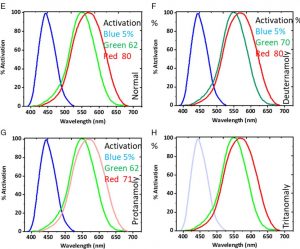
3D Printed Glasses for Color Vision Deficiency 02
The activation of the photoreceptor cells at 520 nm for E) normal, F) deutan, G) protan, and H) tritan.

Glasses based on this approach are commercially and readily available, but they are bulky and can be uncomfortable. The KU research team developed their own frames for their lenses, using 3D printing to optimize the frames for comfort and usability. Inspired by commercially available designs, their 3D printed glasses can fold like other glasses, making them more usable to the wearer.

Research on CVD-management techniques has shown that using dyes can be difficult as leaching and toxicity problems can occur, however the research team tested this to ensure their glasses were safe for long-term use. The stability of the dyes within the 3D printed glasses was examined by storing the glasses in water over a week. Their results showed that no dye leaked into the water, indicating their stability. They also left the glasses open at ambient conditions for a further week, proving their stability and long-lasting properties.

Their mechanical properties were also carefully assessed. Their flexibility and tensile strength are crucial components in quantifying their longevity and durability, and when tested, the glasses exhibited excellent durability, without breaking even when subjected to folding or bending.

“Our results showed that 3D printing had no influence on the wavelength-filtering properties of the dyes,” Dr. Butt said. “In fact, the dyes remained unchanged as they were integrated with the resin and 3D printed. When we compared the optical performance of our glasses with commercial colorblind glasses, our results indicated that our 3D-printed glasses were more selective in filtering undesired wavelengths than the commercially available options. They have great potential in treating colorblindness, and their ease of fabrication and customization means they can be tailored to each individual patient.”

The research work was funded by Sandooq Al Watan and Aldar Properties.

Subscribe to AM Chronicle Newsletter to stay connected:  https://bit.ly/3fBZ1mP 

Follow us on LinkedIn: https://bit.ly/3IjhrFq 

Visit for more interesting content on additive manufacturing: https://amchronicle.com/

Original Source


3D printed glasses 3d printing additive manufacturing color blind Eyes Khalifa University Medical Optical research
AM Chronicle Editorial Team

The AM Chronicle Editorial Team is a collective of passionate individuals committed to delivering insightful, accurate and engaging stories to additive manufacturing audiences worldwide.

NAMIC GLOBAL AM SUMMIT 2025
LATEST FROM AM
Lodestar3D Announces Exclusive Partnership with Prodways Group: Revolutionising Ceramic 3D Printing in India News

Lodestar3D Announces Exclusive Partnership with Prodways Group: Revolutionising Ceramic 3D Printing in India

January 20, 20262 Mins Read
Lodestar3D Boosts Indian Additive Manufacturing with Six TPM3D SLS System Installations News

Lodestar3D Installs Six TPM3D SLS System in Indian Companies

December 27, 20252 Mins Read
ARCI and Raghu Vamsi Machine Tools Sign MoU to Advance Additive Manufacturing and Surface Engineering News

ARCI and Raghu Vamsi Machine Tools Sign MoU to Advance Additive Manufacturing and Surface Engineering

December 26, 20252 Mins Read

CONNECT WITH US

  • 126 A, Dhuruwadi, A. V. Nagvekar Marg, Prabhadevi, Mumbai 400025
  • [email protected]
  • +91 022 24306319
Facebook Instagram YouTube LinkedIn

Newsletter

Subscribe to the AM Chronicle mailer to receive latest tech updates and insights from global industry experts.

SUBSCRIBE NOW

Quick Links

  • News
  • Insights
  • Case Studies
  • AM Training
  • AM Infocast
  • AM Magazine
  • Events

Media

  • Advertise with us
  • Sponsored Articles
  • Media Kit

Events

CNT Expositions & Services
© 2025 CNT Expositions & Services LLP.
  • Privacy Policy
  • Cookie Policy

Type above and press Enter to search. Press Esc to cancel.


0 / 75