

Close Menu
AM ChronicleAM Chronicle
  • Content
    • News
    • Insights
    • Case Studies
    • AM Infocast
  • Focus Regions
    • India
    • Asia Pacific
    • Middle East
    • North America
    • Europe
  • Industries
    • Automotive
    • Aerospace
    • Defence
    • Energy
    • Construction
    • Healthcare
    • Tooling
    • Engineering
  • Training
  • Magazine
    • Digital Issues
  • Events
Facebook Instagram YouTube LinkedIn
  • About us
  • Media Kit
  • Contact us
Facebook Instagram YouTube LinkedIn
AM ChronicleAM Chronicle
  • Content
    1. News
    2. Insights
    3. Case Studies
    4. AM Infocast
    5. View All
    Caracol and RusselSmith Sign a Strategic Partnership to Drive Advanced Manufacturing in West Africa

    Caracol and RusselSmith Sign a Strategic Partnership to Drive Advanced Manufacturing in West Africa

    October 3, 2025
    NAMI and Lockheed Martin Collaborate for Additive Manufacturing Conversion Project

    NAMI and Lockheed Martin Collaborate for Additive Manufacturing Conversion Project 

    September 16, 2025
    LEGO Introduces First Mass-Produced 3D Printed Piece in New Holiday Train Set

    LEGO Introduces First Mass-Produced 3D Printed Piece in New Holiday Train Set

    September 15, 2025
    Boeing Revolutionizes Satellite Production with 3D-Printed Solar Arrays

    Boeing Revolutionizes Satellite Production with 3D-Printed Solar Arrays

    September 15, 2025
    Making Milestones: 3D printing for a greener tomorrow

    Making Milestones: 3D printing for a greener tomorrow

    August 29, 2025
    Nestlé embraces technology and innovation in 3D printing

    Nestlé embraces technology and innovation in 3D printing

    August 29, 2025
    Pure copper and copper alloy (CuCrZr, CuCrNb, CuSn10) samples produced using ADDIREEN's green-laser powder bed fusion AM machines (Image courtesy: Addireen Technologies)

    Addireen: Pioneering Copper Printing in Metal Additive Manufacturing

    August 12, 2025
    Digital Twin Integration in Additive Manufacturing Systems: Revolutionizing Design, Production, and Lifecycle Management

    Digital Twin Integration in Additive Manufacturing Systems: Revolutionizing Design, Production, and Lifecycle Management

    July 4, 2025
    Source: Formlabs

    Case Study: Eaton Corporation’s Strategic Transition to In-House 3D Printing for Tooling Applications

    August 29, 2025
    Revolutionizing Atherosclerosis Research with 3D-Bioprinted Brain Vessels

    Revolutionizing Atherosclerosis Research with 3D-Bioprinted Brain Vessels

    August 25, 2025
    Formlabs fuse 1+

    How Imaginarium Helped Kaash Studio Scale with the Right 3D Printing Technology

    April 12, 2025
    The Formlabs Fuse 1+ 30W

    Kaash Studio Optimized Service Bureau Operations with Formlabs 3D Printers- Case Study

    January 30, 2025
    Sustainable Production of Metal Powder for Additive Manufacturing

    Sustainable Production of Metal Powder for Additive Manufacturing with Bruce Bradshaw

    February 15, 2024
    Meeting Evolving Customer Demands in the Additive Manufacturing Industry with Tyler Reid

    Meeting Evolving Customer Demands in the Additive Manufacturing Industry with Tyler Reid

    February 9, 2024
    Innovation is at the heart of AMUG with Diana Kalisz

    Innovation is at the heart of AMUG with Diana Kalisz

    March 7, 2023
    3D Printing Workshops at AMUG with Edward Graham

    3D Printing Workshops at AMUG with Edward Graham

    March 7, 2023
    Ms. Larissa Smith, Director, Advanced Manufacturing, DRPM, Maritime Industrial Base Program, U.S. Navy, and Mr. Ken Jeanos, VP, Materials and Supply Chain, General Dynamics Electric Boat, are joined by Lincoln Electric leadership and its Additive Solutions team to commemorate the ribbon cutting that marks the investment of four SculptPrint™ 1500 additive manufacturing cells to support the production of critical submarine components.

    U.S. Navy’s Maritime Industrial Base Program, General Dynamics Electric Boat, and Lincoln Electric Advance Additive Manufacturing to Strengthen Submarine Production

    October 3, 2025
    Caracol and RusselSmith Sign a Strategic Partnership to Drive Advanced Manufacturing in West Africa

    Caracol and RusselSmith Sign a Strategic Partnership to Drive Advanced Manufacturing in West Africa

    October 3, 2025

    Book References

    September 20, 2025
    NAMI and Lockheed Martin Collaborate for Additive Manufacturing Conversion Project

    NAMI and Lockheed Martin Collaborate for Additive Manufacturing Conversion Project 

    September 16, 2025
  • Focus Regions
    • India
    • Asia Pacific
    • Middle East
    • North America
    • Europe
  • Industries
    • Automotive
    • Aerospace
    • Defence
    • Energy
    • Construction
    • Healthcare
    • Tooling
    • Engineering
  • Training
  • Magazine
    • Digital Issues
  • Events
Subscribe
AM ChronicleAM Chronicle
Home » News

University of Michigan developed a software “Smart Scan” to make parts faster for metal AM

News By AM Chronicle EditorApril 9, 20224 Mins Read
Smarter 3D printing makes better parts faster mblock 300x200 1
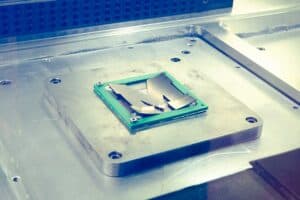
A steel plate in the shape of a Block M is marked with a laser inside the LPBF Panda 11 printer. Image credit: Evan Dougherty/Michigan Engineering
LinkedIn Twitter Facebook WhatsApp Pinterest Email Copy Link

3D printers may soon get better at producing intricate metal and plastic parts, thanks to new software developed at the University of Michigan that reduces harmful heat buildup in laser powder bed fusion printers. Called SmartScan, the software demonstrated a 41% improvement in heat distribution and a 47% reduction in deformations in a recent study.
 

Smarter 3D printing makes better parts faster mblock 300x200 1
A steel plate in the shape of a Block M is marked with a laser inside the LPBF Panda 11 printer. Image credit: Evan Dougherty/Michigan Engineering

It’s also likely to speed the manufacturing process in two ways: by reducing the need for printers to slow down to help with cooling and by significantly reducing heat-caused defects that must be corrected after printing.

Laser powder bed fusion is a form of 3D printing used in aerospace, automotive and biomedical industries to manufacture parts that are too intricate to make with conventional manufacturing. It uses a laser to fuse layers of powdered metal or plastic together. But the laser’s heat can build up in the delicate parts being printed, causing deformation and other defects.

“This problem gets even more serious for parts with really thin features,” said Chinedum Okwudire, U-M associate professor of mechanical engineering and corresponding author of the paper in Additive Manufacturing. “The heat doesn’t have a lot of room to spread, so you need to be smart about how you move the laser around, otherwise your part will deform in really weird ways.”
smarter 3d printing makes better parts faster researchs 1024x682 1
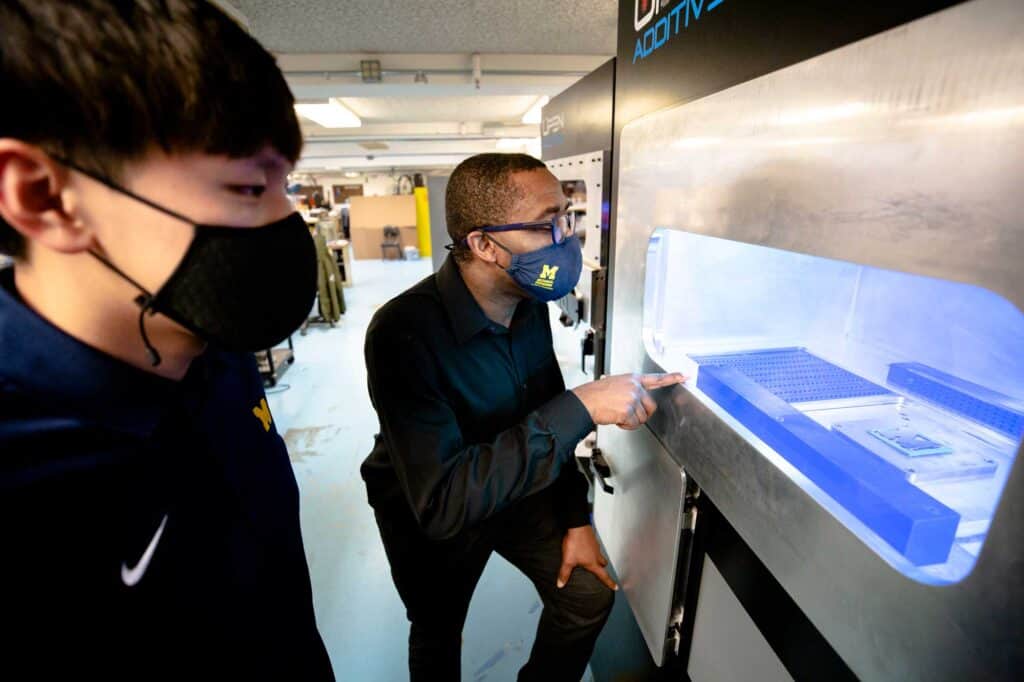
Mechanical engineering Ph.D. candidate Chuan He and associate professor Chinedum Okwudire demonstrate the laser marking procedure using a Panda 11 LPBF printer. Image credit: Evan Dougherty, Michigan Engineering


SmartScan tackles the problem by considering how heat flows within a given part and mapping an optimized scan sequence to limit heat accumulation in any given area. It analyzes the shape of the part and the thermal properties of the material being used, including conductive and convective heat transfer.

AM Chronicle Journal Issue 3

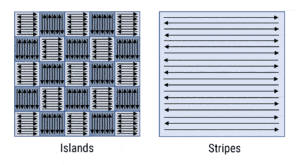
Others in the field have experimented with varying printing patterns to reduce heat buildup, for example by jumping from one area to another or alternating between horizontal and vertical scanning directions. But Okwudire says SmartScan is the first solution that uses a thermal model to optimally guide the laser to distribute heat more evenly.

“When you bring science into it, you can do it in a way that is better and works for even the most intricate parts,” Okwudire said.
smarter 3d printing makes better parts faster sequence patterns 300x165 1
Islands and stripes are two popular scan sequence patterns for LPBF printers. Image credit: Smart and Sustainable Automation Research Lab

To determine the effectiveness of this first version of SmartScan, the researchers used a laser to imprint an identical pattern on two stainless steel plates. They used the SmartScan process for the first plate and switched to traditional printing patterns for the second plate. The prints made with SmartScan were consistently less warped and showed more uniform heat distribution during the marking process than the other methods.

Based on the results of the experiment, the team is confident that, with further research, they’ll be able to adapt SmartScan to build full 3D parts. They plan to further improve the software by factoring the fusing of metal or plastic powder into their thermal modeling, as well as enabling active updating of a scan sequence during printing based on real-time observed temperature measurements using an infrared camera.

“The results are very promising, and we’ve gotten a lot of positive feedback,” said Okwudire, who has started to demonstrate the software to industry partners. “We went with a simple model because it works, and it works better than the trial-and-error approaches used today. We wanted to focus in a direction that is practical and truly has the chance to make a difference.”

The study was supported by the U-M College of Engineering and Department of Mechanical Engineering. The University of Michigan has filed for patent protection and is seeking partners to bring the technology to market.

Subscribe to AM Chronicle Newsletter to stay connected:  https://bit.ly/3fBZ1mP 

Follow us on LinkedIn: https://bit.ly/3IjhrFq 

Visit for more interesting content on additive manufacturing: https://amchronicle.com/

Original Source

3d printing 3D printing research Additive Manufactruing Metal Additive Manufacturing Software University of Michigan
AM Chronicle Editor

NAMIC GLOBAL AM SUMMIT 2025
LATEST FROM AM
Ms. Larissa Smith, Director, Advanced Manufacturing, DRPM, Maritime Industrial Base Program, U.S. Navy, and Mr. Ken Jeanos, VP, Materials and Supply Chain, General Dynamics Electric Boat, are joined by Lincoln Electric leadership and its Additive Solutions team to commemorate the ribbon cutting that marks the investment of four SculptPrint™ 1500 additive manufacturing cells to support the production of critical submarine components. Uncategorized

U.S. Navy’s Maritime Industrial Base Program, General Dynamics Electric Boat, and Lincoln Electric Advance Additive Manufacturing to Strengthen Submarine Production

October 3, 20252 Mins Read
Caracol and RusselSmith Sign a Strategic Partnership to Drive Advanced Manufacturing in West Africa News

Caracol and RusselSmith Sign a Strategic Partnership to Drive Advanced Manufacturing in West Africa

October 3, 20252 Mins Read

Book References

September 20, 20257 Mins Read

CONNECT WITH US

  • 126 A, Dhuruwadi, A. V. Nagvekar Marg, Prabhadevi, Mumbai 400025
  • [email protected]
  • +91 022 24306319
Facebook Instagram YouTube LinkedIn

Newsletter

Subscribe to the AM Chronicle mailer to receive latest tech updates and insights from global industry experts.

SUBSCRIBE NOW

Quick Links

  • News
  • Insights
  • Case Studies
  • AM Training
  • AM Infocast
  • AM Magazine
  • Events

Media

  • Advertise with us
  • Sponsored Articles
  • Media Kit

Events

CNT Expositions & Services
© 2025 CNT Expositions & Services LLP.
  • Privacy Policy
  • Cookie Policy

Type above and press Enter to search. Press Esc to cancel.


0 / 75