

Close Menu
AM ChronicleAM Chronicle
  • Content
    • News
    • Insights
    • Case Studies
    • AM Infocast
  • Focus Regions
    • India
    • Asia Pacific
    • Middle East
    • North America
    • Europe
  • Industries
    • Automotive
    • Aerospace
    • Defence
    • Energy
    • Construction
    • Healthcare
    • Tooling
    • Engineering
  • Training
  • Magazine
    • Digital Issues
  • Events
Facebook Instagram YouTube LinkedIn
  • About us
  • Media Kit
  • Contact us
Facebook Instagram YouTube LinkedIn
AM ChronicleAM Chronicle
  • Content
    1. News
    2. Insights
    3. Case Studies
    4. AM Infocast
    5. View All
    Caracol and RusselSmith Sign a Strategic Partnership to Drive Advanced Manufacturing in West Africa

    Caracol and RusselSmith Sign a Strategic Partnership to Drive Advanced Manufacturing in West Africa

    October 3, 2025
    NAMI and Lockheed Martin Collaborate for Additive Manufacturing Conversion Project

    NAMI and Lockheed Martin Collaborate for Additive Manufacturing Conversion Project 

    September 16, 2025
    LEGO Introduces First Mass-Produced 3D Printed Piece in New Holiday Train Set

    LEGO Introduces First Mass-Produced 3D Printed Piece in New Holiday Train Set

    September 15, 2025
    Boeing Revolutionizes Satellite Production with 3D-Printed Solar Arrays

    Boeing Revolutionizes Satellite Production with 3D-Printed Solar Arrays

    September 15, 2025
    Making Milestones: 3D printing for a greener tomorrow

    Making Milestones: 3D printing for a greener tomorrow

    August 29, 2025
    Nestlé embraces technology and innovation in 3D printing

    Nestlé embraces technology and innovation in 3D printing

    August 29, 2025
    Pure copper and copper alloy (CuCrZr, CuCrNb, CuSn10) samples produced using ADDIREEN's green-laser powder bed fusion AM machines (Image courtesy: Addireen Technologies)

    Addireen: Pioneering Copper Printing in Metal Additive Manufacturing

    August 12, 2025
    Digital Twin Integration in Additive Manufacturing Systems: Revolutionizing Design, Production, and Lifecycle Management

    Digital Twin Integration in Additive Manufacturing Systems: Revolutionizing Design, Production, and Lifecycle Management

    July 4, 2025
    Source: Formlabs

    Case Study: Eaton Corporation’s Strategic Transition to In-House 3D Printing for Tooling Applications

    August 29, 2025
    Revolutionizing Atherosclerosis Research with 3D-Bioprinted Brain Vessels

    Revolutionizing Atherosclerosis Research with 3D-Bioprinted Brain Vessels

    August 25, 2025
    Formlabs fuse 1+

    How Imaginarium Helped Kaash Studio Scale with the Right 3D Printing Technology

    April 12, 2025
    The Formlabs Fuse 1+ 30W

    Kaash Studio Optimized Service Bureau Operations with Formlabs 3D Printers- Case Study

    January 30, 2025
    Sustainable Production of Metal Powder for Additive Manufacturing

    Sustainable Production of Metal Powder for Additive Manufacturing with Bruce Bradshaw

    February 15, 2024
    Meeting Evolving Customer Demands in the Additive Manufacturing Industry with Tyler Reid

    Meeting Evolving Customer Demands in the Additive Manufacturing Industry with Tyler Reid

    February 9, 2024
    Innovation is at the heart of AMUG with Diana Kalisz

    Innovation is at the heart of AMUG with Diana Kalisz

    March 7, 2023
    3D Printing Workshops at AMUG with Edward Graham

    3D Printing Workshops at AMUG with Edward Graham

    March 7, 2023
    Ms. Larissa Smith, Director, Advanced Manufacturing, DRPM, Maritime Industrial Base Program, U.S. Navy, and Mr. Ken Jeanos, VP, Materials and Supply Chain, General Dynamics Electric Boat, are joined by Lincoln Electric leadership and its Additive Solutions team to commemorate the ribbon cutting that marks the investment of four SculptPrint™ 1500 additive manufacturing cells to support the production of critical submarine components.

    U.S. Navy’s Maritime Industrial Base Program, General Dynamics Electric Boat, and Lincoln Electric Advance Additive Manufacturing to Strengthen Submarine Production

    October 3, 2025
    Caracol and RusselSmith Sign a Strategic Partnership to Drive Advanced Manufacturing in West Africa

    Caracol and RusselSmith Sign a Strategic Partnership to Drive Advanced Manufacturing in West Africa

    October 3, 2025

    Book References

    September 20, 2025
    NAMI and Lockheed Martin Collaborate for Additive Manufacturing Conversion Project

    NAMI and Lockheed Martin Collaborate for Additive Manufacturing Conversion Project 

    September 16, 2025
  • Focus Regions
    • India
    • Asia Pacific
    • Middle East
    • North America
    • Europe
  • Industries
    • Automotive
    • Aerospace
    • Defence
    • Energy
    • Construction
    • Healthcare
    • Tooling
    • Engineering
  • Training
  • Magazine
    • Digital Issues
  • Events
Subscribe
AM ChronicleAM Chronicle
Home » News

Team at MIT creates 3D objects that change their appearance from different viewpoints

News By AM Chronicle EditorFebruary 3, 20226 Mins Read
3d Lenticular objects
LinkedIn Twitter Facebook WhatsApp Pinterest Email Copy Link

Picture a birthday card that flickers between images of a birthday cake and flowers as you turn the card and view it from different angles. No doubt you can think of other examples of such morphing images in, say, advertisements. Until now, however, the effect has been limited to flat surfaces but now a team at MIT has made it possible on 3D printed objects. 

Editing tool makes fabrication process available to all

Enter the work of MIT researchers who, for the first time, have developed a system for creating 3D objects that change their appearance when seen from different viewpoints. The same team also developed an editing tool available free online that can allow anyone to design and build such 3D objects, all through 3D printing.

viewpoints. Credit: Zeng et al., MIT

“Our work opens up the idea of what a physical object can be,” says Yunyi Zhu, an MIT graduate student in the Department of Electrical Engineering and Computer Science (EECS). “It’s part of a larger vision for making dynamic objects that change their appearance, color pattern, and shape. We address appearance, which is one dimension of the concept of reprogrammable objects,” says Zhu, who is a co-first author of a paper on the work presented in October at the 2021 Association for Computing Machinery’s Symposium on User Interface Software and Technology.

Stefanie Mueller is the leader of the work, an assistant professor in EECS, and an author of the paper. Mueller is also affiliated with MIT’s Computer Science and Artificial Intelligence Laboratory.

Other co-first authors of the paper are Jiani Zeng (an MIT graduate student who has since graduated) and Honghao Deng (a Harvard graduate student who has since graduated). In addition to Zhu, Zeng, Deng, and Mueller, other authors are Michael Wessely, a postdoctoral associate in EECS, and Axel Kilian, a visiting assistant professor in the Department of Architecture.

“This exciting research radically shifts what the future of product design [will] look like. As an interaction designer, I was stimulated to imagine how in the future everyday physical objects could have thousands of different appearances (colors and patterns) depending on the viewing angles. I can think of many application, from mesmerizing fashion designs to aesthetic sculptures that convey different poetic narratives depending on the viewpoints,” says Ken Nakagaki, a postdoctoral associate at the MIT Media Lab who is an incoming assistant professor at the University of Chicago. Nakagaki was not involved in the work.

How it Works

The changing images on a flat card—and now 3D objects—are thanks to many tiny lenses printed across the card or object. About six of the lenses created by the MIT team could fit across the surface of a dime. Known as lenticular lenses, each lens covers a pattern of tiny colored image spots.

“Because of the magnifying effect of the lens, it displays the color from only one of the colored image spots, which is only a small portion of the entire area under the lens,” the authors write. Which magnified spot the viewer sees depends on the viewer’s viewpoint and the “different incident angles of the light hitting the lens” from that viewpoint. Multiple lenses together “form a lenticular display and collectively show an image that varies dependent on viewpoint.”

The MIT team’s editing tool takes as input the 3D model, or object, that is desired as well as the images that a designer wants to morph from one into another. It then calculates the lens placement and color pattern across the object’s surface that will lead to the desired effect. The designer can then preview the resulting object before sending the “directions” to a 3D printer, where the object, color patterns, and lenses are all printed in one pass.

AM Chronicle Journal Issue 3

Many Applications

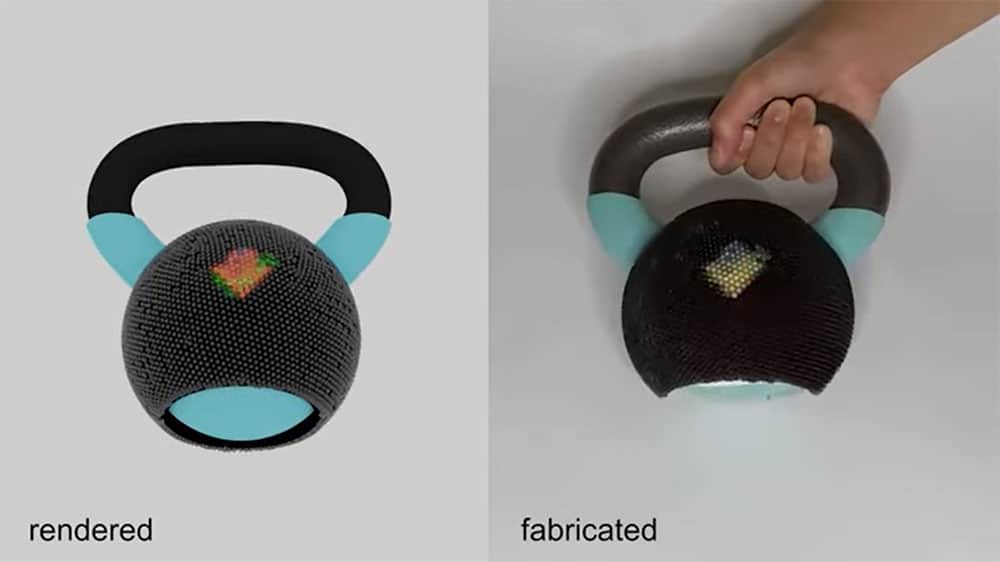
The team went on to create four examples of 3D objects with images that change based on the viewer’s perspective. The idea was to demonstrate the ability to create objects with different geometries, different image complexities, and varying numbers of morphing images. The demonstration objects, each of which are printed with thousands of lenses, include:

kettlebell
A kettlebell guides a user to the correct position for holding the device during exercise. It was created using tools developed at MIT that allow 3D objects to change their appearance from different viewpoints. Credit: Zeng et al., MIT

A kettlebell guides a user to the correct position for holding the device during exercise. It was created using tools developed at MIT that allow 3D objects to change their appearance from different viewpoints.

Credit: Zeng et al., MIT

—a kettlebell for exercise that can indicate to the user whether they are holding the device properly. If the device is too low, an arrow pointing up appears; if too high, an arrow pointing down takes its place. The correct position is indicated with a check mark.

—A bedside lamp shade that displays different greetings depending on whether a person is sitting up in bed (Good Day) or lying down (Good Night).

—A case for earpods that flickers between several colored stripes depending on how the user handles it.

—A shoe printed with a motivational message that only the user can see (the message is invisible to a bypasser or someone standing nearby).

The Sweet Spot

Reasons can be very different. Here is what the psychologist, business coach Yevgeny Yakovlev told the MIR 24 correspondent: “For many years I have been practicing communication techniques with clients in street exercises. For example, techniques for establishing contact and “small conversation. Sometimes it turns out funny free hookup, and sometimes it hurts, to tears.

Zhu says that the major challenge involved in the work was determining the “sweet spot” for the size of each lens. “The smaller the lens, the better the resolution,” she says. “But smaller lenses also have more defects, so the fabrication quality will be worse.” Zhu and colleagues ultimately found that a lens that’s three millimeters in diameter “fits most needs.”

The team also tested other parameters, including the orientation of a lens (for example, printed facing upwards or sideways) and various post-processing techniques for the lenses. Lenses facing upwards and treated with painting varnish led to the best results.

It took about two years to move the project from concept to the creation of demonstration objects. The best part of the work for Zhu was “seeing that the process actually works and holding an object in my hand. That was extremely satisfying.”

This work was supported by the National Science Foundation and by the MIT Materials Research Laboratory under the MIT.nano Immersion Lab Gaming Program funded by NCSOFT.

Subscribe to AM Chronicle Newsletter to stay connected:  https://bit.ly/3fBZ1mP 

Follow us on LinkedIn: https://bit.ly/3IjhrFq 

Visit for more interesting content on additive manufacturing: https://amchronicle.com/

Original Source

3d printing 3D printing research Additive Manufactruing FDM MIT USA
AM Chronicle Editor

NAMIC GLOBAL AM SUMMIT 2025
LATEST FROM AM
Ms. Larissa Smith, Director, Advanced Manufacturing, DRPM, Maritime Industrial Base Program, U.S. Navy, and Mr. Ken Jeanos, VP, Materials and Supply Chain, General Dynamics Electric Boat, are joined by Lincoln Electric leadership and its Additive Solutions team to commemorate the ribbon cutting that marks the investment of four SculptPrint™ 1500 additive manufacturing cells to support the production of critical submarine components. Uncategorized

U.S. Navy’s Maritime Industrial Base Program, General Dynamics Electric Boat, and Lincoln Electric Advance Additive Manufacturing to Strengthen Submarine Production

October 3, 20252 Mins Read
Caracol and RusselSmith Sign a Strategic Partnership to Drive Advanced Manufacturing in West Africa News

Caracol and RusselSmith Sign a Strategic Partnership to Drive Advanced Manufacturing in West Africa

October 3, 20252 Mins Read

Book References

September 20, 20257 Mins Read

CONNECT WITH US

  • 126 A, Dhuruwadi, A. V. Nagvekar Marg, Prabhadevi, Mumbai 400025
  • [email protected]
  • +91 022 24306319
Facebook Instagram YouTube LinkedIn

Newsletter

Subscribe to the AM Chronicle mailer to receive latest tech updates and insights from global industry experts.

SUBSCRIBE NOW

Quick Links

  • News
  • Insights
  • Case Studies
  • AM Training
  • AM Infocast
  • AM Magazine
  • Events

Media

  • Advertise with us
  • Sponsored Articles
  • Media Kit

Events

CNT Expositions & Services
© 2025 CNT Expositions & Services LLP.
  • Privacy Policy
  • Cookie Policy

Type above and press Enter to search. Press Esc to cancel.


0 / 75