

Close Menu
AM ChronicleAM Chronicle
  • Content
    • News
    • Insights
    • Case Studies
    • AM Infocast
  • Focus Regions
    • India
    • Asia Pacific
    • Middle East
    • North America
    • Europe
  • Industries
    • Automotive
    • Aerospace
    • Defence
    • Energy
    • Construction
    • Healthcare
    • Tooling
    • Engineering
  • Training
  • Magazine
    • Digital Issues
  • Events
Facebook Instagram YouTube LinkedIn
  • About us
  • Media Kit
  • Contact us
Facebook Instagram YouTube LinkedIn
AM ChronicleAM Chronicle
  • Content
    1. News
    2. Insights
    3. Case Studies
    4. AM Infocast
    5. View All
    Lodestar3D Boosts Indian Additive Manufacturing with Six TPM3D SLS System Installations

    Lodestar3D Installs Six TPM3D SLS System in Indian Companies

    December 27, 2025
    ARCI and Raghu Vamsi Machine Tools Sign MoU to Advance Additive Manufacturing and Surface Engineering

    ARCI and Raghu Vamsi Machine Tools Sign MoU to Advance Additive Manufacturing and Surface Engineering

    December 26, 2025
    Hang Yu, associate professor of materials science and engineering, with a miniaturized additive friction stir deposition machine used in his advanced manufacturing research. Photo by Peter Means for Virginia Tech.

    Scientists developed a 3D-printed smart composite that allows ceramics to flex under load

    December 25, 2025
    Amandeep Hospitals launches 3D Printing and Virtual Reality Technology facility

    Amandeep Hospitals Unveils North India’s First Hospital-Based 3D Printing and VR Facility

    December 24, 2025
    Gemini Generated Image eyzhd3eyzhd3eyzh

    Breaking the Thermal Barrier: 3D Printing Research on High-Performance Aluminum Alloys Innovates a New Class of Alloys

    December 17, 2025
    Making Milestones: 3D printing for a greener tomorrow

    Making Milestones: 3D printing for a greener tomorrow

    August 29, 2025
    Nestlé embraces technology and innovation in 3D printing

    Nestlé embraces technology and innovation in 3D printing

    August 29, 2025
    Pure copper and copper alloy (CuCrZr, CuCrNb, CuSn10) samples produced using ADDIREEN's green-laser powder bed fusion AM machines (Image courtesy: Addireen Technologies)

    Addireen: Pioneering Copper Printing in Metal Additive Manufacturing

    August 12, 2025
    Source: Formlabs

    Case Study: Eaton Corporation’s Strategic Transition to In-House 3D Printing for Tooling Applications

    August 29, 2025
    Revolutionizing Atherosclerosis Research with 3D-Bioprinted Brain Vessels

    Revolutionizing Atherosclerosis Research with 3D-Bioprinted Brain Vessels

    August 25, 2025
    Formlabs fuse 1+

    How Imaginarium Helped Kaash Studio Scale with the Right 3D Printing Technology

    April 12, 2025
    The Formlabs Fuse 1+ 30W

    Kaash Studio Optimized Service Bureau Operations with Formlabs 3D Printers- Case Study

    January 30, 2025
    Sustainable Production of Metal Powder for Additive Manufacturing

    Sustainable Production of Metal Powder for Additive Manufacturing with Bruce Bradshaw

    February 15, 2024
    Meeting Evolving Customer Demands in the Additive Manufacturing Industry with Tyler Reid

    Meeting Evolving Customer Demands in the Additive Manufacturing Industry with Tyler Reid

    February 9, 2024
    Innovation is at the heart of AMUG with Diana Kalisz

    Innovation is at the heart of AMUG with Diana Kalisz

    March 7, 2023
    3D Printing Workshops at AMUG with Edward Graham

    3D Printing Workshops at AMUG with Edward Graham

    March 7, 2023
    Lodestar3D Boosts Indian Additive Manufacturing with Six TPM3D SLS System Installations

    Lodestar3D Installs Six TPM3D SLS System in Indian Companies

    December 27, 2025
    ARCI and Raghu Vamsi Machine Tools Sign MoU to Advance Additive Manufacturing and Surface Engineering

    ARCI and Raghu Vamsi Machine Tools Sign MoU to Advance Additive Manufacturing and Surface Engineering

    December 26, 2025
    Hang Yu, associate professor of materials science and engineering, with a miniaturized additive friction stir deposition machine used in his advanced manufacturing research. Photo by Peter Means for Virginia Tech.

    Scientists developed a 3D-printed smart composite that allows ceramics to flex under load

    December 25, 2025
    Amandeep Hospitals launches 3D Printing and Virtual Reality Technology facility

    Amandeep Hospitals Unveils North India’s First Hospital-Based 3D Printing and VR Facility

    December 24, 2025
  • Focus Regions
    • India
    • Asia Pacific
    • Middle East
    • North America
    • Europe
  • Industries
    • Automotive
    • Aerospace
    • Defence
    • Energy
    • Construction
    • Healthcare
    • Tooling
    • Engineering
  • Training
  • Magazine
    • Digital Issues
  • Events
Subscribe
AM ChronicleAM Chronicle
Home » News

Stanford and Harvard engineers develop new kind of 3D printing technique

News By AM Chronicle EditorApril 21, 20225 Mins Read
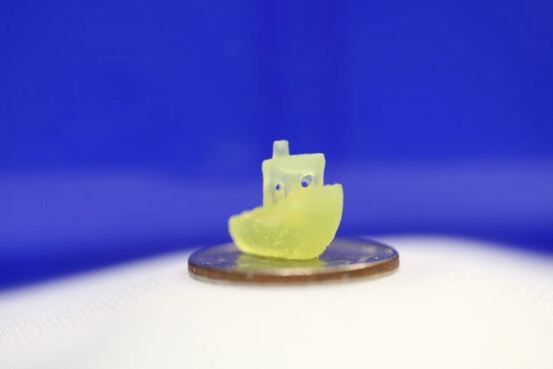
A boat figurine produced by a new 3D printing process
A boat figurine produced by a new 3D printing process that makes it possible to print an object within a volume of resin – like an action figure floating in the center of a block of Jell-O – rather than having to build the object layer by layer. (Image credit: Dan Congreve)
LinkedIn Twitter Facebook WhatsApp Pinterest Email Copy Link

Engineers at Stanford and Harvard have laid the groundwork for a new system for 3D printing that doesn’t require that an object be printed from the bottom up.

More from the News 

While 3D printing techniques have advanced significantly in the last decade, the technology continues to face a fundamental limitation: objects must be built up layer by layer. But what if they didn’t have to be?

Dan Congreve, an assistant professor of electrical engineering at Stanford and former Rowland Fellow at the Rowland Institute at Harvard University, and his colleagues have developed a way to print 3D objects within a stationary volume of resin. The printed object is fully supported by the thick resin – imagine an action figure floating in the center of a block of Jell-O – so it can be added to from any angle. This removes the need for the support structures typically required for creating complex designs with more standard printing methods. The new 3D printing system, which was recently published in Nature, could make it easier to print increasingly intricate designs while saving time and material.

“The ability to do this volumetric printing enables you to print objects that were previously very difficult,” said Congreve. “It’s a very exciting opportunity for three-dimensional printing going forward.”

Printing with light

At its surface, the technique seems relatively straightforward: The researchers focused a laser through a lens and shone it into a gelatinous resin that hardens when exposed to blue light. But Congreve and his colleagues couldn’t simply use a blue laser – the resin would cure along the entire length of the beam. Instead, they used a red light and some cleverly designed nanomaterials scattered throughout resin to create blue light at only the precise focal point of the laser. By shifting the laser around the container of resin, they were able to create detailed, support-free prints.
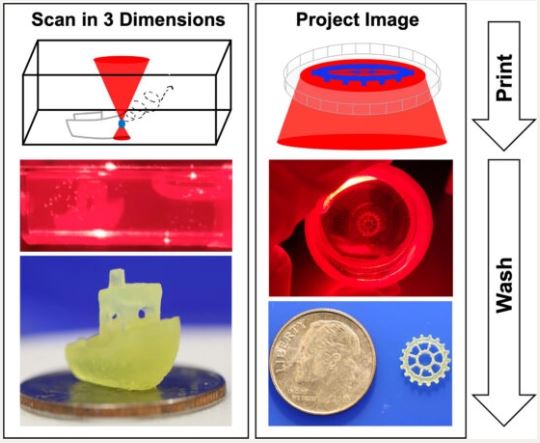
A boat figurine produced by a new 3D printing process.2
Changing the contents of the nanocapsules controls the power of red light required to cure the resin and allows for different types of volumetric printing. Two types of printing shown here: scanning and tracing an image using a high-powered laser (on left) and projecting an image all at once using a low-powered LED (on right). (Image credit: Dan Congreve/Tracy H. Schloemer/Arynn O. Gallegos)

Congreve’s lab specializes in converting one wavelength of light to another using a method called triplet fusion upconversion. With the right molecules in close proximity to each other, the researchers can create a chain of energy transfers that, for example, turn low-energy red photons into high-energy blue ones.

“I got interested in this upconversion technique back in grad school,” Congreve said. “It has all sorts of interesting applications in solar, bio, and now this 3D printing. Our real specialty is in the nanomaterials themselves – engineering them to emit the right wavelength of light, to emit it efficiently, and to be dispersed in resin.”

Through a series of steps (which included sending some of their materials for a spin in a Vitamix blender), Congreve and his colleagues were able to form the necessary upconversion molecules into distinct nanoscale droplets and coat them in a protective silica shell. Then they distributed the resulting nanocapsules, each of which is 1000 times smaller than the width of a human hair, throughout the resin.

“Figuring out how to make the nanocapsules robust was not trivial – a 3D-printing resin is actually pretty harsh,” said Tracy Schloemer, a postdoctoral researcher in Congreve’s lab and one of the lead authors on the paper. “And if those nanocapsules start falling apart, your ability to do upconversion goes away. All your contents spill out and you can’t get those molecular collisions that you need.”

 

AM Chronicle Journal Issue 3

Next steps for light-converting nanocapsules

The researchers are currently working on ways to refine their 3D-printing technique. They are investigating the possibility of printing multiple points at the same time, which would speed up the process considerably, as well as printing at higher resolutions and smaller scales.

Congreve is also exploring other opportunities to put the upconverting nanocapsules to use. They may be able to help improve the efficiency of solar panels, for example, by converting unusable low-energy light into wavelengths the solar cells can collect. Or they could be used to help researchers more precisely study biological models that can be triggered with light or even, in the future, deliver localized treatments.

“You could penetrate tissue with infrared light and then turn that infrared light into high-energy light with this upconversion technique to, for example, drive a chemical reaction,” said Congreve. “Our ability to control materials at the nanoscale gives us a lot of really cool opportunities to solve challenging problems that are otherwise difficult to approach.”

Subscribe to AM Chronicle Newsletter to stay connected:  https://bit.ly/3fBZ1mP 

Follow us on LinkedIn: https://bit.ly/3IjhrFq 

Visit for more interesting content on additive manufacturing: https://amchronicle.com/

Original Source

3d printing 3D printing research Additive Manuafacturing harvard Laser Stanford
AM Chronicle Editor

NAMIC GLOBAL AM SUMMIT 2025
LATEST FROM AM
Lodestar3D Boosts Indian Additive Manufacturing with Six TPM3D SLS System Installations News

Lodestar3D Installs Six TPM3D SLS System in Indian Companies

December 27, 20252 Mins Read
ARCI and Raghu Vamsi Machine Tools Sign MoU to Advance Additive Manufacturing and Surface Engineering News

ARCI and Raghu Vamsi Machine Tools Sign MoU to Advance Additive Manufacturing and Surface Engineering

December 26, 20252 Mins Read
Hang Yu, associate professor of materials science and engineering, with a miniaturized additive friction stir deposition machine used in his advanced manufacturing research. Photo by Peter Means for Virginia Tech. News

Scientists developed a 3D-printed smart composite that allows ceramics to flex under load

December 25, 20254 Mins Read

CONNECT WITH US

  • 126 A, Dhuruwadi, A. V. Nagvekar Marg, Prabhadevi, Mumbai 400025
  • [email protected]
  • +91 022 24306319
Facebook Instagram YouTube LinkedIn

Newsletter

Subscribe to the AM Chronicle mailer to receive latest tech updates and insights from global industry experts.

SUBSCRIBE NOW

Quick Links

  • News
  • Insights
  • Case Studies
  • AM Training
  • AM Infocast
  • AM Magazine
  • Events

Media

  • Advertise with us
  • Sponsored Articles
  • Media Kit

Events

CNT Expositions & Services
© 2025 CNT Expositions & Services LLP.
  • Privacy Policy
  • Cookie Policy

Type above and press Enter to search. Press Esc to cancel.


0 / 75