

Close Menu
AM ChronicleAM Chronicle
  • Content
    • News
    • Insights
    • Case Studies
    • AM Infocast
  • Focus Regions
    • India
    • Asia Pacific
    • Middle East
    • North America
    • Europe
  • Industries
    • Automotive
    • Aerospace
    • Defence
    • Energy
    • Construction
    • Healthcare
    • Tooling
    • Engineering
  • Training
  • Magazine
    • Digital Issues
  • Events
Facebook Instagram YouTube LinkedIn
  • About us
  • Media Kit
  • Contact us
Facebook Instagram YouTube LinkedIn
AM ChronicleAM Chronicle
  • Content
    1. News
    2. Insights
    3. Case Studies
    4. AM Infocast
    5. View All
    Bahrain’s First Advanced Additive Manufacturing Hub Launched

    Bahrain Launches First Advanced Additive Manufacturing Hub in Partnership with Roboze

    December 12, 2025
    Airbus Now 3D Printing Over 25,000 Flight-Ready Plastic Parts Annually

    Airbus Now 3D Printing Over 25,000 Flight-Ready Plastic Parts Annually

    December 12, 2025
    Caracol and RusselSmith Sign a Strategic Partnership to Drive Advanced Manufacturing in West Africa

    Caracol and RusselSmith Sign a Strategic Partnership to Drive Advanced Manufacturing in West Africa

    October 3, 2025
    NAMI and Lockheed Martin Collaborate for Additive Manufacturing Conversion Project

    NAMI and Lockheed Martin Collaborate for Additive Manufacturing Conversion Project 

    September 16, 2025
    Making Milestones: 3D printing for a greener tomorrow

    Making Milestones: 3D printing for a greener tomorrow

    August 29, 2025
    Nestlé embraces technology and innovation in 3D printing

    Nestlé embraces technology and innovation in 3D printing

    August 29, 2025
    Pure copper and copper alloy (CuCrZr, CuCrNb, CuSn10) samples produced using ADDIREEN's green-laser powder bed fusion AM machines (Image courtesy: Addireen Technologies)

    Addireen: Pioneering Copper Printing in Metal Additive Manufacturing

    August 12, 2025
    Digital Twin Integration in Additive Manufacturing Systems: Revolutionizing Design, Production, and Lifecycle Management

    Digital Twin Integration in Additive Manufacturing Systems: Revolutionizing Design, Production, and Lifecycle Management

    July 4, 2025
    Source: Formlabs

    Case Study: Eaton Corporation’s Strategic Transition to In-House 3D Printing for Tooling Applications

    August 29, 2025
    Revolutionizing Atherosclerosis Research with 3D-Bioprinted Brain Vessels

    Revolutionizing Atherosclerosis Research with 3D-Bioprinted Brain Vessels

    August 25, 2025
    Formlabs fuse 1+

    How Imaginarium Helped Kaash Studio Scale with the Right 3D Printing Technology

    April 12, 2025
    The Formlabs Fuse 1+ 30W

    Kaash Studio Optimized Service Bureau Operations with Formlabs 3D Printers- Case Study

    January 30, 2025
    Sustainable Production of Metal Powder for Additive Manufacturing

    Sustainable Production of Metal Powder for Additive Manufacturing with Bruce Bradshaw

    February 15, 2024
    Meeting Evolving Customer Demands in the Additive Manufacturing Industry with Tyler Reid

    Meeting Evolving Customer Demands in the Additive Manufacturing Industry with Tyler Reid

    February 9, 2024
    Innovation is at the heart of AMUG with Diana Kalisz

    Innovation is at the heart of AMUG with Diana Kalisz

    March 7, 2023
    3D Printing Workshops at AMUG with Edward Graham

    3D Printing Workshops at AMUG with Edward Graham

    March 7, 2023
    Bahrain’s First Advanced Additive Manufacturing Hub Launched

    Bahrain Launches First Advanced Additive Manufacturing Hub in Partnership with Roboze

    December 12, 2025
    Airbus Now 3D Printing Over 25,000 Flight-Ready Plastic Parts Annually

    Airbus Now 3D Printing Over 25,000 Flight-Ready Plastic Parts Annually

    December 12, 2025
    Ms. Larissa Smith, Director, Advanced Manufacturing, DRPM, Maritime Industrial Base Program, U.S. Navy, and Mr. Ken Jeanos, VP, Materials and Supply Chain, General Dynamics Electric Boat, are joined by Lincoln Electric leadership and its Additive Solutions team to commemorate the ribbon cutting that marks the investment of four SculptPrint™ 1500 additive manufacturing cells to support the production of critical submarine components.

    U.S. Navy’s Maritime Industrial Base Program, General Dynamics Electric Boat, and Lincoln Electric Advance Additive Manufacturing to Strengthen Submarine Production

    October 3, 2025
    Caracol and RusselSmith Sign a Strategic Partnership to Drive Advanced Manufacturing in West Africa

    Caracol and RusselSmith Sign a Strategic Partnership to Drive Advanced Manufacturing in West Africa

    October 3, 2025
  • Focus Regions
    • India
    • Asia Pacific
    • Middle East
    • North America
    • Europe
  • Industries
    • Automotive
    • Aerospace
    • Defence
    • Energy
    • Construction
    • Healthcare
    • Tooling
    • Engineering
  • Training
  • Magazine
    • Digital Issues
  • Events
Subscribe
AM ChronicleAM Chronicle
Home » News

Researchers Create Stable Hybrid Laser by 3D Printing Micro-Optics onto Fibers

News By AM Chronicle Editorial TeamDecember 19, 20234 Mins Read
3d Printed Micro-Optics
LinkedIn Twitter Facebook WhatsApp Pinterest Email Copy Link

Researchers have shown that 3D-printed polymer-based micro-optics can withstand the heat and power levels that occur inside a laser. The advancement enables inexpensive compact and stable laser sources that would be useful in a variety of applications, including the lidar systems used for autonomous vehicles.

The researchers 3D-printed microscale optics directly onto optical fibers to combine fibers and laser crystals inside a single laser oscillator in a compact way. The resulting hybrid laser exhibited stable operation at output powers of over 20 mW at 1063.4 nm and had a maximum output power of 37 mW.

“We significantly reduced the size of a laser by using 3D printing to fabricate high-quality micro-optics directly on glass fibers used inside of lasers,” said research team leader Simon Angstenberger from the 4th Physics Institute at University of Stuttgart in Germany. “This is the first implementation of such 3D-printed optics in a real-world laser, highlighting their high damage threshold and stability.”

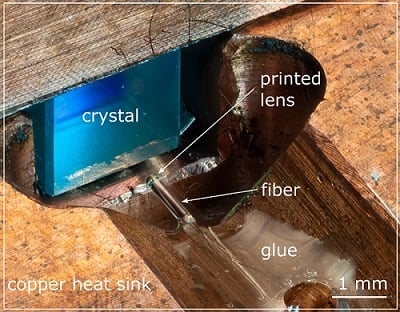
Researchers printed microscale lenses directly onto optical fibers, allowing them to compactly combine fibers and laser crystals inside a single laser oscillator. Courtesy of Moritz Floess and Simon Angstenberger/4th Physics Institute at University of Stuttgart in Germany.

The new laser combines the compactness, robustness, and low cost of fiber-based lasers with the advantages of crystal-based solid-state lasers, which can have a broad range of properties such as different powers and colors.

“Until now, 3D-printed optics have primarily been used for low-power applications such as endoscopy,” Angstenberger said. “The ability to use them with high-power applications could be useful for lithography and laser marking, for example. We showed that these 3D micro-optics printed onto fibers can be used to focus large amounts of light down to a single point, which could be useful for medical applications such as precisely destroying cancerous tissue.”

The team uses a 3D-printing approach known as two-photon polymerization, which focuses an infrared laser into a ultraviolet-sensitive photoresist. In the laser’s focal region, two infrared photons will be absorbed simultaneously, which hardens the UV resist. Moving the focus around allows various shapes to be created with high precision. This method use can be used to create miniaturized optics and also allows novel functionalities such as the creation of free-form optics or complex lens systems.

“Because these 3D-printed elements are made of polymers, it was unclear whether they could withstand the significant amount of heat load and optical power that occurs inside a laser cavity,” Angstenberger said. “We found that they are surprisingly stable, and we were not able to observe any kind of damage on the lenses even after several hours of running the laser.”

For the new study, the researchers used a 3D printer made by Nanoscribe to fabricate lenses with a 0.25-mm diameter and 80-µm height onto the end of a fiber with the same diameter using two-photon polymerization. This involved designing an optical element with commercial software, inserting the fiber into the 3D printer, and printing the small structure on the end of the fiber. This process must be extremely precise in terms of aligning the printing to the fiber and the accuracy of the printing itself.

After the printing was complete, the researchers assembled the laser and the laser cavity. Rather than using a crystal inside a laser cavity made of bulky and costly mirrors, they used fibers to form part of the cavity, creating a hybrid fiber-crystal laser. The lenses printed at the end of the fibers focus and collect — or couple — the light into and out of the laser crystal. They then glued the fibers into a mount to make the laser system more stable and less susceptible to air turbulence. The crystal and the printed lenses measured just 5 × 5 cm2.

Continuously recording the laser power over several hours verified that the printed optics inside the system did not deteriorate or affect the long-term properties of the laser. Additionally, scanning electron microscopy images of the optics after use in the laser cavity did not show any visible damage. “Interestingly, we found that the printed optics were more stable than the commercial fiber Bragg grating we used, which ended up limiting our maximum power,” Angstenberger said.

The researchers are now working to optimize the efficiency of the printed optics. Larger fibers with optimized freeform and aspherical lens designs or a combination of lenses printed directly onto the fiber could help improve the output power. They would also like to demonstrate different crystals in the laser, which could allow the output to be customized for specific applications.

Subscribe to AM Chronicle Newsletter to stay connected:  https://bit.ly/3fBZ1mP 

Follow us on LinkedIn: https://bit.ly/3IjhrFq 

Visit for more interesting content on additive manufacturing: https://amchronicle.com

Original Source

3d printing Micro-Optics
AM Chronicle Editorial Team

The AM Chronicle Editorial Team is a collective of passionate individuals committed to delivering insightful, accurate and engaging stories to additive manufacturing audiences worldwide.

NAMIC GLOBAL AM SUMMIT 2025
LATEST FROM AM
Bahrain’s First Advanced Additive Manufacturing Hub Launched Middle East

Bahrain Launches First Advanced Additive Manufacturing Hub in Partnership with Roboze

December 12, 20252 Mins Read
Airbus Now 3D Printing Over 25,000 Flight-Ready Plastic Parts Annually News

Airbus Now 3D Printing Over 25,000 Flight-Ready Plastic Parts Annually

December 12, 20252 Mins Read
Ms. Larissa Smith, Director, Advanced Manufacturing, DRPM, Maritime Industrial Base Program, U.S. Navy, and Mr. Ken Jeanos, VP, Materials and Supply Chain, General Dynamics Electric Boat, are joined by Lincoln Electric leadership and its Additive Solutions team to commemorate the ribbon cutting that marks the investment of four SculptPrint™ 1500 additive manufacturing cells to support the production of critical submarine components. Uncategorized

U.S. Navy’s Maritime Industrial Base Program, General Dynamics Electric Boat, and Lincoln Electric Advance Additive Manufacturing to Strengthen Submarine Production

October 3, 20252 Mins Read

CONNECT WITH US

  • 126 A, Dhuruwadi, A. V. Nagvekar Marg, Prabhadevi, Mumbai 400025
  • [email protected]
  • +91 022 24306319
Facebook Instagram YouTube LinkedIn

Newsletter

Subscribe to the AM Chronicle mailer to receive latest tech updates and insights from global industry experts.

SUBSCRIBE NOW

Quick Links

  • News
  • Insights
  • Case Studies
  • AM Training
  • AM Infocast
  • AM Magazine
  • Events

Media

  • Advertise with us
  • Sponsored Articles
  • Media Kit

Events

CNT Expositions & Services
© 2025 CNT Expositions & Services LLP.
  • Privacy Policy
  • Cookie Policy

Type above and press Enter to search. Press Esc to cancel.


0 / 75