

Close Menu
AM ChronicleAM Chronicle
  • Content
    • News
    • Insights
    • Case Studies
    • AM Infocast
  • Focus Regions
    • India
    • Asia Pacific
    • Middle East
    • North America
    • Europe
  • Industries
    • Automotive
    • Aerospace
    • Defence
    • Energy
    • Construction
    • Healthcare
    • Tooling
    • Engineering
  • Training
  • Magazine
    • Digital Issues
  • Events
Facebook Instagram YouTube LinkedIn
  • About us
  • Media Kit
  • Contact us
Facebook Instagram YouTube LinkedIn
AM ChronicleAM Chronicle
  • Content
    1. News
    2. Insights
    3. Case Studies
    4. AM Infocast
    5. View All
    Lodestar3D Announces Exclusive Partnership with Prodways Group: Revolutionising Ceramic 3D Printing in India

    Lodestar3D Announces Exclusive Partnership with Prodways Group: Revolutionising Ceramic 3D Printing in India

    January 20, 2026
    Lodestar3D Boosts Indian Additive Manufacturing with Six TPM3D SLS System Installations

    Lodestar3D Installs Six TPM3D SLS System in Indian Companies

    December 27, 2025
    ARCI and Raghu Vamsi Machine Tools Sign MoU to Advance Additive Manufacturing and Surface Engineering

    ARCI and Raghu Vamsi Machine Tools Sign MoU to Advance Additive Manufacturing and Surface Engineering

    December 26, 2025
    Hang Yu, associate professor of materials science and engineering, with a miniaturized additive friction stir deposition machine used in his advanced manufacturing research. Photo by Peter Means for Virginia Tech.

    Scientists developed a 3D-printed smart composite that allows ceramics to flex under load

    December 25, 2025
    Gemini Generated Image eyzhd3eyzhd3eyzh

    Breaking the Thermal Barrier: 3D Printing Research on High-Performance Aluminum Alloys Innovates a New Class of Alloys

    December 17, 2025
    Making Milestones: 3D printing for a greener tomorrow

    Making Milestones: 3D printing for a greener tomorrow

    August 29, 2025
    Nestlé embraces technology and innovation in 3D printing

    Nestlé embraces technology and innovation in 3D printing

    August 29, 2025
    Pure copper and copper alloy (CuCrZr, CuCrNb, CuSn10) samples produced using ADDIREEN's green-laser powder bed fusion AM machines (Image courtesy: Addireen Technologies)

    Addireen: Pioneering Copper Printing in Metal Additive Manufacturing

    August 12, 2025
    Source: Formlabs

    Case Study: Eaton Corporation’s Strategic Transition to In-House 3D Printing for Tooling Applications

    August 29, 2025
    Revolutionizing Atherosclerosis Research with 3D-Bioprinted Brain Vessels

    Revolutionizing Atherosclerosis Research with 3D-Bioprinted Brain Vessels

    August 25, 2025
    Formlabs fuse 1+

    How Imaginarium Helped Kaash Studio Scale with the Right 3D Printing Technology

    April 12, 2025
    The Formlabs Fuse 1+ 30W

    Kaash Studio Optimized Service Bureau Operations with Formlabs 3D Printers- Case Study

    January 30, 2025
    Sustainable Production of Metal Powder for Additive Manufacturing

    Sustainable Production of Metal Powder for Additive Manufacturing with Bruce Bradshaw

    February 15, 2024
    Meeting Evolving Customer Demands in the Additive Manufacturing Industry with Tyler Reid

    Meeting Evolving Customer Demands in the Additive Manufacturing Industry with Tyler Reid

    February 9, 2024
    Innovation is at the heart of AMUG with Diana Kalisz

    Innovation is at the heart of AMUG with Diana Kalisz

    March 7, 2023
    3D Printing Workshops at AMUG with Edward Graham

    3D Printing Workshops at AMUG with Edward Graham

    March 7, 2023
    Lodestar3D Announces Exclusive Partnership with Prodways Group: Revolutionising Ceramic 3D Printing in India

    Lodestar3D Announces Exclusive Partnership with Prodways Group: Revolutionising Ceramic 3D Printing in India

    January 20, 2026
    Lodestar3D Boosts Indian Additive Manufacturing with Six TPM3D SLS System Installations

    Lodestar3D Installs Six TPM3D SLS System in Indian Companies

    December 27, 2025
    ARCI and Raghu Vamsi Machine Tools Sign MoU to Advance Additive Manufacturing and Surface Engineering

    ARCI and Raghu Vamsi Machine Tools Sign MoU to Advance Additive Manufacturing and Surface Engineering

    December 26, 2025
    Hang Yu, associate professor of materials science and engineering, with a miniaturized additive friction stir deposition machine used in his advanced manufacturing research. Photo by Peter Means for Virginia Tech.

    Scientists developed a 3D-printed smart composite that allows ceramics to flex under load

    December 25, 2025
  • Focus Regions
    • India
    • Asia Pacific
    • Middle East
    • North America
    • Europe
  • Industries
    • Automotive
    • Aerospace
    • Defence
    • Energy
    • Construction
    • Healthcare
    • Tooling
    • Engineering
  • Training
  • Magazine
    • Digital Issues
  • Events
Subscribe
AM ChronicleAM Chronicle
Home » News

Relativity is using AI-Powered Robots to 3D Print Entire Rockets

News By Aditya ChandavarkarNovember 5, 20195 Mins Read
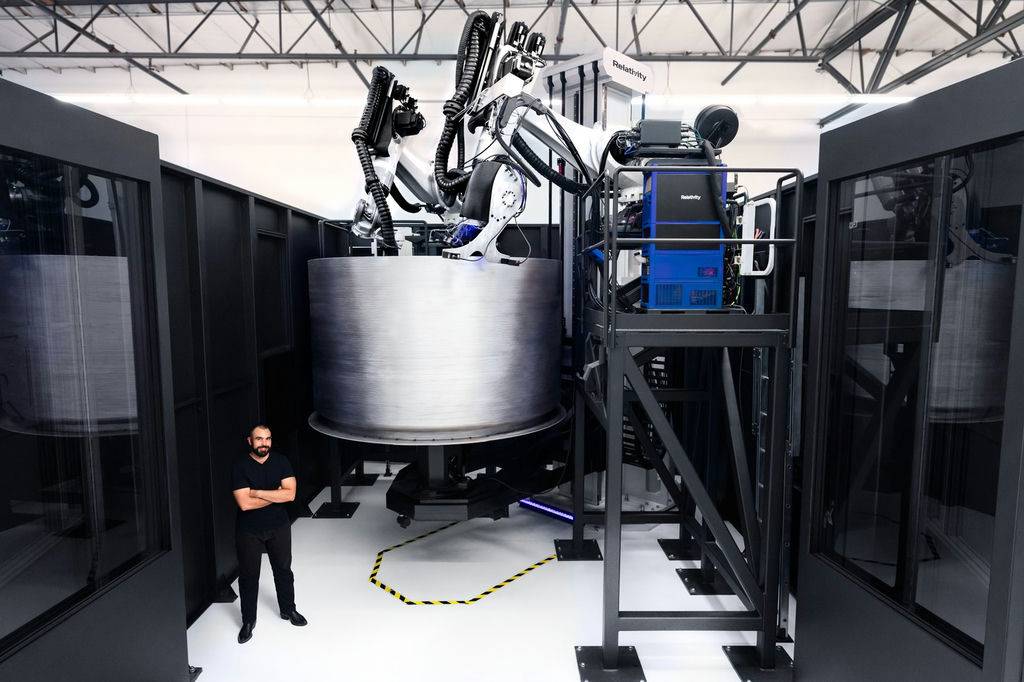
Jordan Noone, Relativity's CTO and cofounder, stands beside the second version of the Stargate 3D printer at the company's headquarters. Source: Relativity
LinkedIn Twitter Facebook WhatsApp Pinterest Email Copy Link

Relativity Space may have the biggest metal 3D printers in the world, and they’re cranking out parts to reinvent the rocket industry here—and on Mars.

For a factory where robots toil around the clock to build a rocket with almost no human labor, the sound of grunts echoing across the parking lot make for a jarring contrast.

“That’s Keanu Reeves’ stunt gym,” says Tim Ellis, the chief executive and cofounder of Relativity Space, a startup that wants to combine 3D printing and artificial intelligence to do for the rocket what Henry Ford did for the automobile. As we walk among the robots occupying Relativity’s factory, he points out the just-completed upper stage of the company’s rocket, which will soon be shipped to Mississippi for its first tests. Across the way, he says, gesturing to the outside world, is a recording studio run by Snoop Dogg.

Neither of those A-listers have paid a visit to Relativity’s rocket factory, but the presence of these unlikely neighbors seems to underscore the company’s main talking point: It can make rockets anywhere. In an ideal cosmos, though, its neighbors will be even more alien than Snoop Dogg. Relativity wants to not just build rockets, but to build them on Mars. How exactly? The answer, says Ellis, is robots—lots of them.
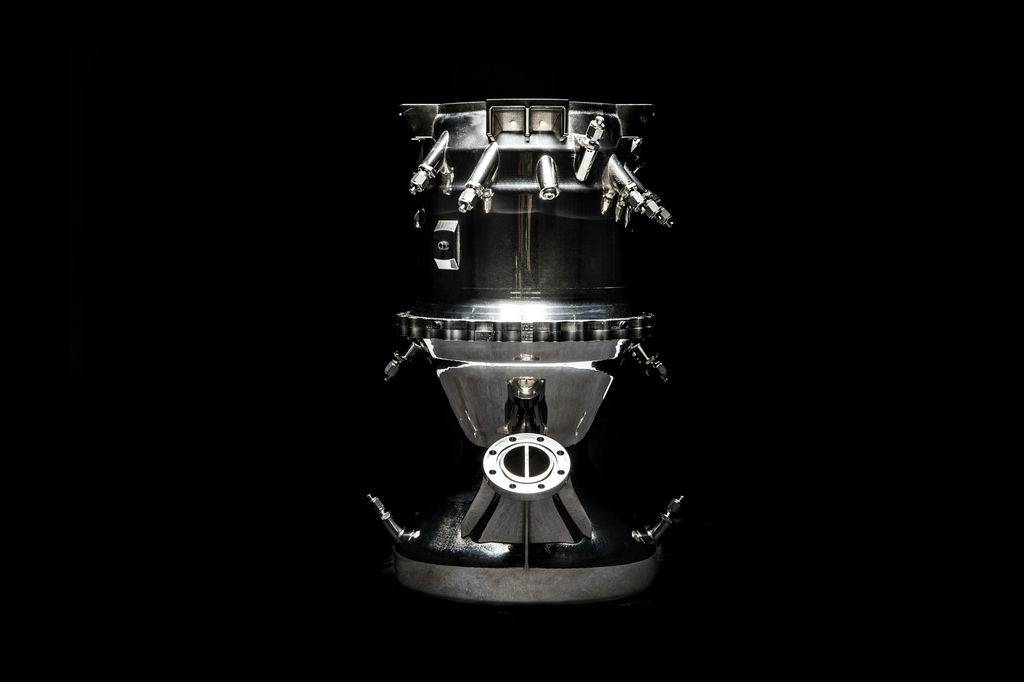
To make a 3D-printable rocket, Relativity Space simplified the design of many components, including the engine. Source: Relativity.

Roll up the loading bay doors at Relativity’s Los Angeles headquarters and you’ll find four of the largest metal 3D printers in the world, churning out rocket parts day and night. The latest model of the company’s proprietary printer, dubbed Stargate, stands 30 feet tall and has two massive robotic arms that protrude like tentacles from the machine. The Stargate printers will manufacture about 95 percent, by mass, of Relativity’s first rocket, named Terran-1. The only parts that won’t be printed are the electronics, cables, and a handful of moving parts and rubber gaskets.

To make a rocket 3D-printable, Ellis’s team had to totally rethink the way rockets are designed. As a result, Terran-1 will have 100 times fewer parts than a comparable rocket. Its Aeon engine, for instance, consists of just 100 parts, whereas a typical liquid-fueled rocket would have thousands. By consolidating parts and optimizing them for 3D printing, Ellis says Relativity will be able to go from raw materials to the launch pad in just 60 days—in theory, anyway. Relativity hasn’t yet assembled a full Terran-1 and doesn’t expect the rocket to fly until 2021 at the earliest.

“A full-scale test will be the biggest milestone for them to prove this new technology,” says Shagun Sachdeva, a senior analyst at Northern Sky Research, a space consultancy. Then the company can start to address the other questions about its approach, such as whether there’s a need for a new rocket to pop into existence every 60 days.

Relativity thinks it will find its niche. Fully assembled, Terran-1 will stand about 100 feet tall, and be capable of delivering satellites weighing up to 2,800 pounds to low Earth orbit. That puts it above small satellite launchers like Rocket Lab’s Electron but well under the payload capacity of massive rockets like SpaceX’s Falcon 9. Ellis says it will be particularly well-suited to carrying medium-sized satellites.

Relativity isn’t the only rocket company using 3D printing—SpaceX, Blue Origin, Rocket Lab, and others also use it to print select parts. But Ellis thinks the space industry needs to think bigger. In the long term, Ellis sees 3D-printed rockets as the key to transporting critical infrastructure to and from the surface of Mars. These rockets could, for example, be used to loft science experiments into orbit around Mars or return samples to Earth.

Ellis, 29, and his cofounder, 26-year-old Jordan Noone, have been building rockets since college, where they worked on the University of Southern California’s prestigious rocketry team before taking jobs at Blue Origin and SpaceX. At Blue Origin, Ellis helped set up the company’s additive manufacturing program. While there, he began to envision a robotic rocket factory that barely needs a human’s hand.

First, though, he needed to get some giant 3D printers. At the heart of Relativity’s robotic rocket factory is Stargate, which Ellis claims is the largest metal 3D printer in the world. The first version of Stargate is about 15 feet tall and consists of three robotic arms. The arms are used to weld metal, monitor the printer’s progress, and correct for defects.

https://amchronicle.com/wp-content/uploads/2019/11/screenrecording_science_inline1.mp4
Every new iteration of the Stargate printer has been significantly bigger than the last, allowing it to churn out very large rocket parts in one piece. Video Source: Relativity.

To print a large component, such as a fuel tank or rocket body, the printer feeds miles of a thin, custom-made aluminum alloy wire along the length of an arm to its tip, where a plasma arc melts the metal. The arm then deposits the molten metal in thin layers, orchestrating its movements according to patterns programmed in the machine’s software. Meanwhile, the printer head at the tip of the arm blows out a non-oxidizing gas to create a sort of “clean room” at the deposition site.

Relativity now has a new version of Stargate that can, in a single go, print even bigger components, like the rocket’s fairing or fuel chambers. It stands twice as tall and has only two arms, which can each perform more tasks than their predecessors. Ellis said its next Stargate will double in size yet again, which will eventually allow the company to produce larger rockets.

Source: Wired.com

Aditya Chandavarkar
Aditya Chandavarkar
Website
Aditya Chandavarkar is a established entrepreneur with business interests in manufacturing, innovative technology, training and consulting. Among other activities he the Co-Founder of Indian 3D Printing Network and is a subject matter expert on 3D Printing/Additive Manufacturing with good grasp of Additive Manufacturing trends in the Region including India, APAC, Middleeast and Africa.
3d printing additive manufacturing Aerospace AI Relativity Robotics Rockets Space Travel Wired
Aditya Chandavarkar
  • Website

Aditya Chandavarkar is a established entrepreneur with business interests in manufacturing, innovative technology, training and consulting. Among other activities he the Co-Founder of Indian 3D Printing Network and is a subject matter expert on 3D Printing/Additive Manufacturing with good grasp of Additive Manufacturing trends in the Region including India, APAC, Middleeast and Africa.

NAMIC GLOBAL AM SUMMIT 2025
LATEST FROM AM
Lodestar3D Announces Exclusive Partnership with Prodways Group: Revolutionising Ceramic 3D Printing in India News

Lodestar3D Announces Exclusive Partnership with Prodways Group: Revolutionising Ceramic 3D Printing in India

January 20, 20262 Mins Read
Lodestar3D Boosts Indian Additive Manufacturing with Six TPM3D SLS System Installations News

Lodestar3D Installs Six TPM3D SLS System in Indian Companies

December 27, 20252 Mins Read
ARCI and Raghu Vamsi Machine Tools Sign MoU to Advance Additive Manufacturing and Surface Engineering News

ARCI and Raghu Vamsi Machine Tools Sign MoU to Advance Additive Manufacturing and Surface Engineering

December 26, 20252 Mins Read

CONNECT WITH US

  • 126 A, Dhuruwadi, A. V. Nagvekar Marg, Prabhadevi, Mumbai 400025
  • [email protected]
  • +91 022 24306319
Facebook Instagram YouTube LinkedIn

Newsletter

Subscribe to the AM Chronicle mailer to receive latest tech updates and insights from global industry experts.

SUBSCRIBE NOW

Quick Links

  • News
  • Insights
  • Case Studies
  • AM Training
  • AM Infocast
  • AM Magazine
  • Events

Media

  • Advertise with us
  • Sponsored Articles
  • Media Kit

Events

CNT Expositions & Services
© 2025 CNT Expositions & Services LLP.
  • Privacy Policy
  • Cookie Policy

Type above and press Enter to search. Press Esc to cancel.


0 / 75