

Close Menu
AM ChronicleAM Chronicle
  • Content
    • News
    • Insights
    • Case Studies
    • AM Infocast
  • Focus Regions
    • India
    • Asia Pacific
    • Middle East
    • North America
    • Europe
  • Industries
    • Automotive
    • Aerospace
    • Defence
    • Energy
    • Construction
    • Healthcare
    • Tooling
    • Engineering
  • Training
  • Magazine
    • Digital Issues
  • Events
Facebook Instagram YouTube LinkedIn
  • About us
  • Media Kit
  • Contact us
Facebook Instagram YouTube LinkedIn
AM ChronicleAM Chronicle
  • Content
    1. News
    2. Insights
    3. Case Studies
    4. AM Infocast
    5. View All
    Lodestar3D Boosts Indian Additive Manufacturing with Six TPM3D SLS System Installations

    Lodestar3D Installs Six TPM3D SLS System in Indian Companies

    December 27, 2025
    ARCI and Raghu Vamsi Machine Tools Sign MoU to Advance Additive Manufacturing and Surface Engineering

    ARCI and Raghu Vamsi Machine Tools Sign MoU to Advance Additive Manufacturing and Surface Engineering

    December 26, 2025
    Hang Yu, associate professor of materials science and engineering, with a miniaturized additive friction stir deposition machine used in his advanced manufacturing research. Photo by Peter Means for Virginia Tech.

    Scientists developed a 3D-printed smart composite that allows ceramics to flex under load

    December 25, 2025
    Amandeep Hospitals launches 3D Printing and Virtual Reality Technology facility

    Amandeep Hospitals Unveils North India’s First Hospital-Based 3D Printing and VR Facility

    December 24, 2025
    Gemini Generated Image eyzhd3eyzhd3eyzh

    Breaking the Thermal Barrier: 3D Printing Research on High-Performance Aluminum Alloys Innovates a New Class of Alloys

    December 17, 2025
    Making Milestones: 3D printing for a greener tomorrow

    Making Milestones: 3D printing for a greener tomorrow

    August 29, 2025
    Nestlé embraces technology and innovation in 3D printing

    Nestlé embraces technology and innovation in 3D printing

    August 29, 2025
    Pure copper and copper alloy (CuCrZr, CuCrNb, CuSn10) samples produced using ADDIREEN's green-laser powder bed fusion AM machines (Image courtesy: Addireen Technologies)

    Addireen: Pioneering Copper Printing in Metal Additive Manufacturing

    August 12, 2025
    Source: Formlabs

    Case Study: Eaton Corporation’s Strategic Transition to In-House 3D Printing for Tooling Applications

    August 29, 2025
    Revolutionizing Atherosclerosis Research with 3D-Bioprinted Brain Vessels

    Revolutionizing Atherosclerosis Research with 3D-Bioprinted Brain Vessels

    August 25, 2025
    Formlabs fuse 1+

    How Imaginarium Helped Kaash Studio Scale with the Right 3D Printing Technology

    April 12, 2025
    The Formlabs Fuse 1+ 30W

    Kaash Studio Optimized Service Bureau Operations with Formlabs 3D Printers- Case Study

    January 30, 2025
    Sustainable Production of Metal Powder for Additive Manufacturing

    Sustainable Production of Metal Powder for Additive Manufacturing with Bruce Bradshaw

    February 15, 2024
    Meeting Evolving Customer Demands in the Additive Manufacturing Industry with Tyler Reid

    Meeting Evolving Customer Demands in the Additive Manufacturing Industry with Tyler Reid

    February 9, 2024
    Innovation is at the heart of AMUG with Diana Kalisz

    Innovation is at the heart of AMUG with Diana Kalisz

    March 7, 2023
    3D Printing Workshops at AMUG with Edward Graham

    3D Printing Workshops at AMUG with Edward Graham

    March 7, 2023
    Lodestar3D Boosts Indian Additive Manufacturing with Six TPM3D SLS System Installations

    Lodestar3D Installs Six TPM3D SLS System in Indian Companies

    December 27, 2025
    ARCI and Raghu Vamsi Machine Tools Sign MoU to Advance Additive Manufacturing and Surface Engineering

    ARCI and Raghu Vamsi Machine Tools Sign MoU to Advance Additive Manufacturing and Surface Engineering

    December 26, 2025
    Hang Yu, associate professor of materials science and engineering, with a miniaturized additive friction stir deposition machine used in his advanced manufacturing research. Photo by Peter Means for Virginia Tech.

    Scientists developed a 3D-printed smart composite that allows ceramics to flex under load

    December 25, 2025
    Amandeep Hospitals launches 3D Printing and Virtual Reality Technology facility

    Amandeep Hospitals Unveils North India’s First Hospital-Based 3D Printing and VR Facility

    December 24, 2025
  • Focus Regions
    • India
    • Asia Pacific
    • Middle East
    • North America
    • Europe
  • Industries
    • Automotive
    • Aerospace
    • Defence
    • Energy
    • Construction
    • Healthcare
    • Tooling
    • Engineering
  • Training
  • Magazine
    • Digital Issues
  • Events
Subscribe
AM ChronicleAM Chronicle
Home » News

Rapid Casting for Shorter Delivery Times of Prototypes

News By AM Chronicle Editorial TeamMay 15, 20184 Mins Read
Rapid Casting
LinkedIn Twitter Facebook WhatsApp Pinterest Email Copy Link

[ihc-hide-content ihc_mb_type=”show” ihc_mb_who=”reg” ihc_mb_template=”3″ ]

[vc_row][vc_column][vc_column_text]Credits: www.spotlightmetal.com

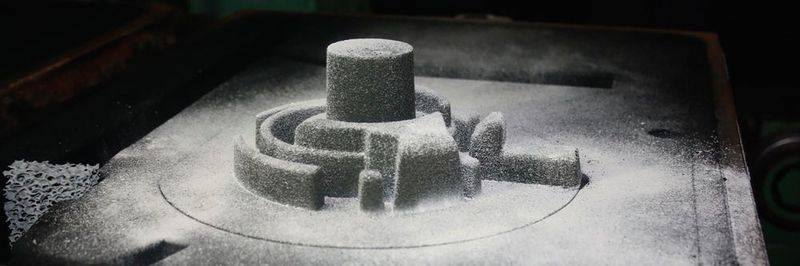
The most time-consuming process in an iron foundry is modeling. This is because the path from data processing and milling of the outer models and the core forming geometries to the assembly of the core boxes is time consuming and often leads to time-critical bottlenecks. To avoid this problem, many customers used to weld their prototypes from sheet metal or even manually carve them from the solid material. This leads to the loss of freeforms and up to 80 % of the material. Until now, these were the only options available for all those who, despite late orders from end customers or delays in the design process, still required the real components on time for the next trade fair, the announced start of series production or the start of a field test. But that’s not a satisfying solution. In order to quickly obtain prototypes made of the series-material and manufactured in the process used in series production, the time required for modeling must be reduced.

Compared to the actual costs for series-raw casting, the additive production of molds and cores is considerably more expensive. However, prototypes or small series can be delivered within ten working days, if complex quality tests are skipped. One beneficiary of this process is the MAN foundry in Augsburg, which now produces many spare parts for the shipping industry in printed molds. At first glance, the costs of 20,000 to 30,000 Euros for the molds seem to be absurd. But when a ship is waiting for spare part in port, the costs quickly climb to 50,000 Euros per day.

How Rapid Casting Works

The iron foundry Brechmann-Guss also uses this advantage for development projects of its customers. The time saved in shorter product development or thanks to the penalty-free handling of a development project very quickly compensates for the higher costs of the process. In order to keep costs and deadlines under control, the East Westphalian iron foundry pursues two strategies:

  • Rapid Casting: the fastest possible casting based on the 3D data supplied without consideration of drafts and undercuts;
  • 4S prototyping: series-identical prototypes in series material, under series production conditions, in series geometry, and, if necessary, in series test status.

The ideal conception is that Brechmann-Guss produces the outer geometry of the castings conventionally by means of a milled outer model, but the core-formed inner geometries consist of 3D-printed sand cores. Against the background that in conventional production the construction of the core boxes takes the longest and, on the other hand, subsequent modification requests of customers mostly concern the internal geometries, changes to the geometry can be quickly implemented. In this way, the foundry can produce prototypes within ten working days.

Finally, Brechmann-Guss supplies series-produced prototypes suitable for series production using the “series process of machine mold casting”. If the component then goes into series production, pilot series requirements — or a small series for field trials — can still be produced with 3D printed cores, while series core boxes are produced in parallel. The hurry that occurred during new part start-ups is a thing of the past. There are only two aspects to consider:

  • machining the 3D data provided by the customer (fillets, draft angles, graduation planes, feed and so on) ready for series production costs just as much time as
  • complex measurements and tests required by the customer after the casting is finished.

Not Everything Has to Be Measured

Under the first aspect, rapid casting is suitable for the fastest possible production of a few prototypes. From the practical point of view, the second aspect raises the question of whether, for example, a complete 3D measurement is really necessary for a field test before the delivery of prototypes. Ultimately, it is sufficient to measure five main masses as long as the entire manufacturing process is focused on the 3D dataset. Because if the model built according to the 3D dataset is accurate, either all values are correct, or all values are wrong. The measurement of 80 instead of five masses provides little or no further information in this context.

Various projects that have already been carried out have delivered further advantages: All of a sudden, parts that couldn’t be cast at all became castable. In conventional processes, complex core packages consisting of several individual cores are often bonded; the tolerance chain becomes longer with each additional bonded core and the scrap that accrues in the foundry increases to the same extent. The Brechmann foundry therefore considers the use of printed cores for complex internal geometries as a real alternative.

[/vc_column_text][/vc_column][/vc_row]

[/ihc-hide-content]

AM Chronicle
AM Chronicle Editorial Team
3d print india 3d printing india 3d printing industry 3DPrinting additive manufacturing
AM Chronicle Editorial Team

The AM Chronicle Editorial Team is a collective of passionate individuals committed to delivering insightful, accurate and engaging stories to additive manufacturing audiences worldwide.

NAMIC GLOBAL AM SUMMIT 2025
LATEST FROM AM
Lodestar3D Boosts Indian Additive Manufacturing with Six TPM3D SLS System Installations News

Lodestar3D Installs Six TPM3D SLS System in Indian Companies

December 27, 20252 Mins Read
ARCI and Raghu Vamsi Machine Tools Sign MoU to Advance Additive Manufacturing and Surface Engineering News

ARCI and Raghu Vamsi Machine Tools Sign MoU to Advance Additive Manufacturing and Surface Engineering

December 26, 20252 Mins Read
Hang Yu, associate professor of materials science and engineering, with a miniaturized additive friction stir deposition machine used in his advanced manufacturing research. Photo by Peter Means for Virginia Tech. News

Scientists developed a 3D-printed smart composite that allows ceramics to flex under load

December 25, 20254 Mins Read

CONNECT WITH US

  • 126 A, Dhuruwadi, A. V. Nagvekar Marg, Prabhadevi, Mumbai 400025
  • [email protected]
  • +91 022 24306319
Facebook Instagram YouTube LinkedIn

Newsletter

Subscribe to the AM Chronicle mailer to receive latest tech updates and insights from global industry experts.

SUBSCRIBE NOW

Quick Links

  • News
  • Insights
  • Case Studies
  • AM Training
  • AM Infocast
  • AM Magazine
  • Events

Media

  • Advertise with us
  • Sponsored Articles
  • Media Kit

Events

CNT Expositions & Services
© 2025 CNT Expositions & Services LLP.
  • Privacy Policy
  • Cookie Policy

Type above and press Enter to search. Press Esc to cancel.


0 / 75