

MIT PhD student Alexander O’Brien is working to deliver the next generation of fusion devices through research on additive manufacturing of metal-ceramic composites.
When Alexander O’Brien sent in his application for graduate school at MIT’s Department of Nuclear Science and Engineering, he had a germ of a research idea already brewing. So when he received a phone call from Professor Mingda Li, he shared it: The student from Arkansas wanted to explore the design of materials that could hold nuclear reactors together.
Li listened to him patiently and then said, “I think you’d be a really good fit for Professor Ju Li,” O’Brien remembers. Ju Li, the Battelle Energy Alliance Professor in Nuclear Engineering, had wanted to explore 3D printing for nuclear reactors and O’Brien seemed like the right candidate. “At that moment I decided to go to MIT if they accepted me,” O’Brien remembers.
And they did.
Under the advisement of Ju Li, the fourth-year doctoral student now explores 3D printing of ceramic-metal composites, materials that can be used to construct fusion power plants.
An early interest in the sciences
Growing up in Springdale, Arkansas as a self-described “band nerd,” O’Brien was particularly interested in chemistry and physics. It was one thing to mix baking soda and vinegar to make a “volcano” and quite another to understand why that was happening. “I just enjoyed understanding things on a deeper level and being able to figure out how the world works,” he says.
At the same time, it was difficult to ignore the economics of energy playing out in his own backyard. When Arkansas, a place that had hardly ever seen earthquakes, started registering them in the wake of fracking in neighboring Oklahoma, it was “like a lightbulb moment” for O’Brien. “I knew this was going to create problems down the line, I knew there’s got to be a better way to do [energy],” he says.
With the idea of energy alternatives simmering on the back burner, O’Brien enrolled for undergraduate studies at the University of Arkansas. He participated in the school’s marching band — “you show up a week before everyone else and there’s 400 people who automatically become your friends” — and enjoyed the social environment that a large state school could offer.
O’Brien double-majored in chemical engineering and physics and appreciated “the ability to get your hands dirty on machinery to make things work.” Deciding to begin exploring his interest in energy alternatives, O’Brien researched transition metal dichalcogenides, coatings of which could catalyze the hydrogen evolution reaction and more easily create hydrogen gas, a green energy alternative.
It was shortly after his sophomore year, however, that O’Brien really found his way in the field of energy alternatives — in nuclear engineering. The American Chemical Society was soliciting student applications for summer study of nuclear chemistry in San Jose, California. O’Brien applied and got accepted. “After years of knowing I wanted to work in green energy but not knowing what that looked like, I very quickly fell in love with [nuclear engineering],” he says. That summer also cemented O’Brien’s decision to attend graduate school. “I came away with this idea of ‘I need to go to grad school because I need to know more about this,’” he says.
O’Brien especially appreciated an independent project, assigned as part of the summer program: He chose to research nuclear-powered spacecraft. In digging deeper, O’Brien discovered the challenges of powering spacecraft — nuclear was the most viable alternative, but it had to work around extraneous radiation sources in space. Getting to explore national laboratories near San Jose sealed the deal. “I got to visit the National Ignition Facility, which is the big fusion center up there, and just seeing that massive facility entirely designed around this one idea of fusion was kind of mind-blowing to me,” O’Brien says.
A fresh blueprint for fusion power plants
O’Brien’s current research at MIT’s Department of Nuclear Science and Engineering (NSE) is equally mind-blowing.
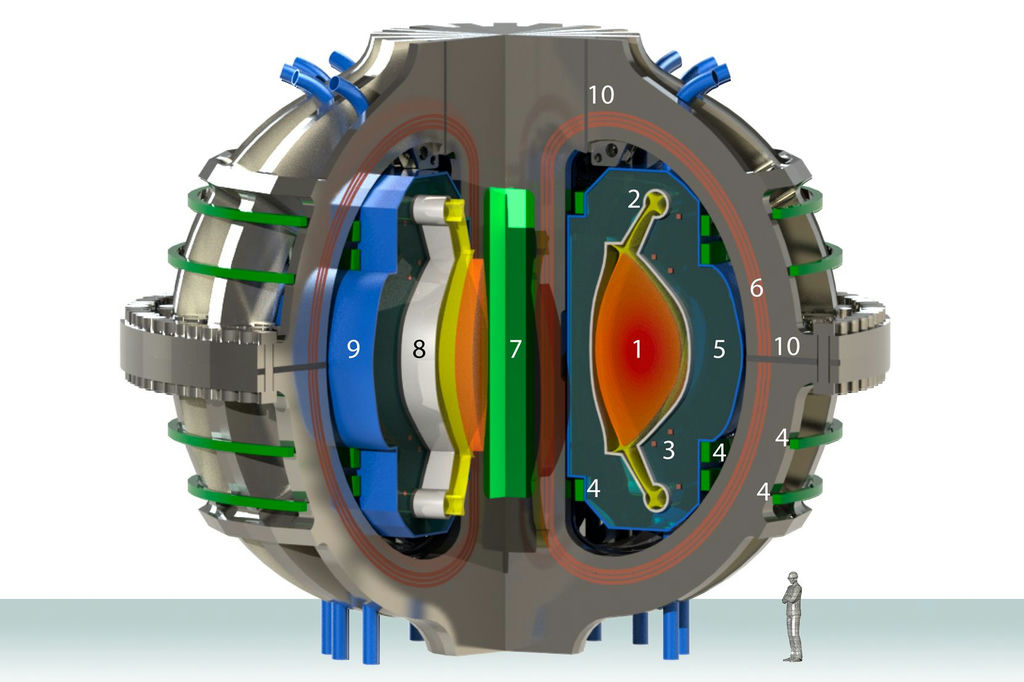
As the design of new fusion devices kicks into gear, it’s becoming increasingly apparent that the materials we have been using just don’t hold up to the higher temperatures and radiation levels in operating environments, O’Brien says. Additive manufacturing, another term for 3D printing, “opens up a whole new realm of possibilities for what you can do with metals, which is exactly what you’re going to need [to build the next generation of fusion power plants],” he says.
Metals and ceramics by themselves might not do the job of withstanding high temperatures (750 degrees Celsius is the target) and stresses and radiation, but together they might get there. Although such metal matrix composites have been around for decades, they have been impractical for use in reactors because they’re “difficult to make with any kind of uniformity and really limited in size scale,” O’Brien says. That’s because when you try to place ceramic nanoparticles into a pool of molten metal, they’re going to fall out in whichever direction they want. “3D printing quickly changes that story entirely, to the point where if you want to add these nanoparticles in very specific regions, you have the capability to do that,” O’Brien says.
O’Brien’s work, which forms the basis of his doctoral thesis and a research paper in the journal Additive Manufacturing, involves implanting metals with ceramic nanoparticles. The net result is a metal matrix composite that is an ideal candidate for fusion devices, especially for the vacuum vessel component, which must be able to withstand high temperatures, extremely corrosive molten salts, and internal helium gas from nuclear transmutation.
O’Brien’s work focuses on nickel superalloys like Inconel 718, which are especially robust candidates because they can withstand higher operating temperatures while retaining strength. Helium embrittlement, where bubbles of helium caused by fusion neutrons lead to weakness and failure, is a problem with Inconel 718, but composites exhibit potential to overcome this challenge.
To create the composites, first a mechanical milling process coats the ceramic onto the metal particles. The ceramic nanoparticles act as reinforcing strength agents, especially at high temperatures, and make materials last longer. The nanoparticles also absorb helium and radiation defects when uniformly dispersed, which prevent these damage agents from all getting to the grain boundaries.
The composite then goes through a 3D printing process called powder bed fusion (non-nuclear fusion), where a laser passes over a bed of this powder melting it into desired shapes. “By coating these particles with the ceramic and then only melting very specific regions, we keep the ceramics in the areas that we want, and then you can build up and have a uniform structure,” O’Brien says.
Printing an exciting future
The 3D printing of nuclear materials exhibits such promise that O’Brien is looking at pursuing the prospect after his doctoral studies. “The concept of these metal matrix composites and how they can enhance material property is really interesting,” he says. Scaling it up commercially through a startup company is on his radar.
For now, O’Brien is enjoying research and catching an occasional Broadway show with his wife. While the band nerd doesn’t pick up his saxophone much anymore, he does enjoy driving up to New Hampshire and going backpacking. “That’s my newfound hobby,” O’Brien says, “since I started grad school.”
Subscribe to AM Chronicle Newsletter to stay connected: https://bit.ly/3fBZ1mP
Follow us on LinkedIn: https://bit.ly/3IjhrFq
Visit for more interesting content on additive manufacturing: https://amchronicle.com