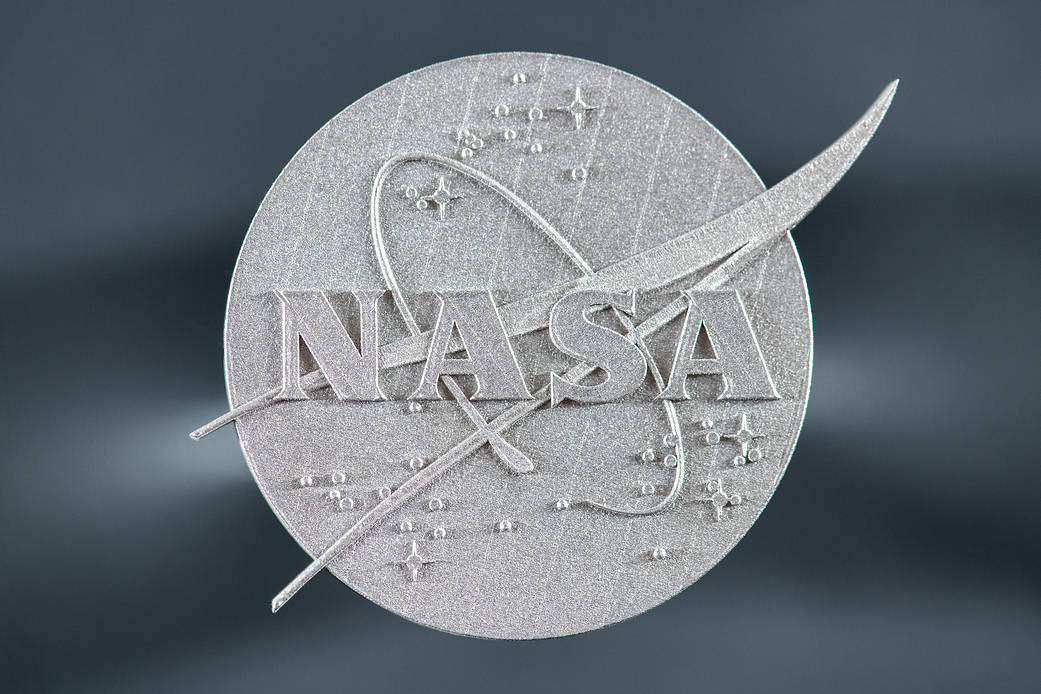
Macro Photographs of 3D Print of NASA Meatball - Made out of GRX-810, an Oxide Dispersion Strengthened (ODS) High Temperature Alloy
NASA has demonstrated a breakthrough in 3D printable high-temperature materials that could lead to stronger, more durable parts for airplanes and spacecraft.
A team of innovators from NASA and The Ohio State University detailed the characteristics of the new alloy, GRX-810, in a peer-reviewed paper published in the journal Nature.
“This superalloy has the potential to dramatically improve the strength and toughness of components and parts used in aviation and space exploration,” said Dr. Tim Smith of NASA’s Glenn Research Center in Cleveland, lead author of the Nature paper. Smith and his Glenn colleague Christopher Kantzos invented GRX-810.
Smith and his team employed time-saving computer modeling, as well as a laser 3D printing process that fused metals together, layer-by-layer, to create the new alloy. They used this process to produce the NASA logo pictured above.
GRX-810 is an oxide dispersion strengthened alloy. In other words, tiny particles containing oxygen atoms spread throughout the alloy enhance its strength. Such alloys are excellent candidates to build aerospace parts for high-temperature applications, like those inside aircraft and rocket engines, because they can withstand harsher conditions before reaching their breaking points.
Current state-of-the-art 3D printed superalloys can withstand temperatures up to 2,000 degrees Fahrenheit. Compared to those, GRX-810 is twice as strong, over 1,000 times more durable, and twice as resistant to oxidation.
“This new alloy is a major achievement,” said Dale Hopkins, deputy project manager of NASA’s Transformational Tools and Technologies project. “In the very near future, it may well be one of the most successful technology patents NASA Glenn has ever produced.”
A team of contributors from Glenn, NASA’s Ames Research Center in California’s Silicon Valley, NASA’s Marshall Space Flight Center in Huntsville, Alabama, and The Ohio State University co-authored the Nature paper.
GRX-810 was developed under NASA’s Transformational Tools and Technologies project, with support from the agency’s Game Changing Development Program.
Brian Newbacher
NASA’s Glenn Research Center
Image credit: NASA/ Jordan Salkin
Subscribe to AM Chronicle Newsletter to stay connected: https://bit.ly/3fBZ1mP
Follow us on LinkedIn: https://bit.ly/3IjhrFq
Visit for more interesting content on additive manufacturing: https://amchronicle.com
Bengaluru, India – January 19, 2026 – Lodestar3D, a premier provider of advanced manufacturing solutions…
Lodestar3D, a prominent distributor of industrial 3D printing solutions in India, has announced the successful…
The International Advanced Research Centre for Powder Metallurgy and New Materials (ARCI) has signed a…
Since his postdoctoral days at MIT, Hang Yu, associate professor of materials science and engineering,…
Amritsar-based Amandeep Hospitals, in collaboration with Ujala Cygnus, has inaugurated North India’s first hospital-based 3D Printing and Virtual…
Engineers at The University of Texas at Austin are leading an academic and industry all-star…
This website uses cookies.