

Close Menu
AM ChronicleAM Chronicle
  • Content
    • News
    • Insights
    • Case Studies
    • AM Infocast
  • Focus Regions
    • India
    • Asia Pacific
    • Middle East
    • North America
    • Europe
  • Industries
    • Automotive
    • Aerospace
    • Defence
    • Energy
    • Construction
    • Healthcare
    • Tooling
    • Engineering
  • Training
  • Magazine
    • Digital Issues
  • Events
Facebook Instagram YouTube LinkedIn
  • About us
  • Media Kit
  • Contact us
Facebook Instagram YouTube LinkedIn
AM ChronicleAM Chronicle
  • Content
    1. News
    2. Insights
    3. Case Studies
    4. AM Infocast
    5. View All
    Caracol and RusselSmith Sign a Strategic Partnership to Drive Advanced Manufacturing in West Africa

    Caracol and RusselSmith Sign a Strategic Partnership to Drive Advanced Manufacturing in West Africa

    October 3, 2025
    NAMI and Lockheed Martin Collaborate for Additive Manufacturing Conversion Project

    NAMI and Lockheed Martin Collaborate for Additive Manufacturing Conversion Project 

    September 16, 2025
    LEGO Introduces First Mass-Produced 3D Printed Piece in New Holiday Train Set

    LEGO Introduces First Mass-Produced 3D Printed Piece in New Holiday Train Set

    September 15, 2025
    Boeing Revolutionizes Satellite Production with 3D-Printed Solar Arrays

    Boeing Revolutionizes Satellite Production with 3D-Printed Solar Arrays

    September 15, 2025
    Making Milestones: 3D printing for a greener tomorrow

    Making Milestones: 3D printing for a greener tomorrow

    August 29, 2025
    Nestlé embraces technology and innovation in 3D printing

    Nestlé embraces technology and innovation in 3D printing

    August 29, 2025
    Pure copper and copper alloy (CuCrZr, CuCrNb, CuSn10) samples produced using ADDIREEN's green-laser powder bed fusion AM machines (Image courtesy: Addireen Technologies)

    Addireen: Pioneering Copper Printing in Metal Additive Manufacturing

    August 12, 2025
    Digital Twin Integration in Additive Manufacturing Systems: Revolutionizing Design, Production, and Lifecycle Management

    Digital Twin Integration in Additive Manufacturing Systems: Revolutionizing Design, Production, and Lifecycle Management

    July 4, 2025
    Source: Formlabs

    Case Study: Eaton Corporation’s Strategic Transition to In-House 3D Printing for Tooling Applications

    August 29, 2025
    Revolutionizing Atherosclerosis Research with 3D-Bioprinted Brain Vessels

    Revolutionizing Atherosclerosis Research with 3D-Bioprinted Brain Vessels

    August 25, 2025
    Formlabs fuse 1+

    How Imaginarium Helped Kaash Studio Scale with the Right 3D Printing Technology

    April 12, 2025
    The Formlabs Fuse 1+ 30W

    Kaash Studio Optimized Service Bureau Operations with Formlabs 3D Printers- Case Study

    January 30, 2025
    Sustainable Production of Metal Powder for Additive Manufacturing

    Sustainable Production of Metal Powder for Additive Manufacturing with Bruce Bradshaw

    February 15, 2024
    Meeting Evolving Customer Demands in the Additive Manufacturing Industry with Tyler Reid

    Meeting Evolving Customer Demands in the Additive Manufacturing Industry with Tyler Reid

    February 9, 2024
    Innovation is at the heart of AMUG with Diana Kalisz

    Innovation is at the heart of AMUG with Diana Kalisz

    March 7, 2023
    3D Printing Workshops at AMUG with Edward Graham

    3D Printing Workshops at AMUG with Edward Graham

    March 7, 2023
    Ms. Larissa Smith, Director, Advanced Manufacturing, DRPM, Maritime Industrial Base Program, U.S. Navy, and Mr. Ken Jeanos, VP, Materials and Supply Chain, General Dynamics Electric Boat, are joined by Lincoln Electric leadership and its Additive Solutions team to commemorate the ribbon cutting that marks the investment of four SculptPrint™ 1500 additive manufacturing cells to support the production of critical submarine components.

    U.S. Navy’s Maritime Industrial Base Program, General Dynamics Electric Boat, and Lincoln Electric Advance Additive Manufacturing to Strengthen Submarine Production

    October 3, 2025
    Caracol and RusselSmith Sign a Strategic Partnership to Drive Advanced Manufacturing in West Africa

    Caracol and RusselSmith Sign a Strategic Partnership to Drive Advanced Manufacturing in West Africa

    October 3, 2025

    Book References

    September 20, 2025
    NAMI and Lockheed Martin Collaborate for Additive Manufacturing Conversion Project

    NAMI and Lockheed Martin Collaborate for Additive Manufacturing Conversion Project 

    September 16, 2025
  • Focus Regions
    • India
    • Asia Pacific
    • Middle East
    • North America
    • Europe
  • Industries
    • Automotive
    • Aerospace
    • Defence
    • Energy
    • Construction
    • Healthcare
    • Tooling
    • Engineering
  • Training
  • Magazine
    • Digital Issues
  • Events
Subscribe
AM ChronicleAM Chronicle
Home » News

MUSE: Modification in Stellarator Design with 3D Printed Housing

News By Chinmay SarafApril 29, 20243 Mins Read
muse 20230803 summerinterns2023 r6a9676
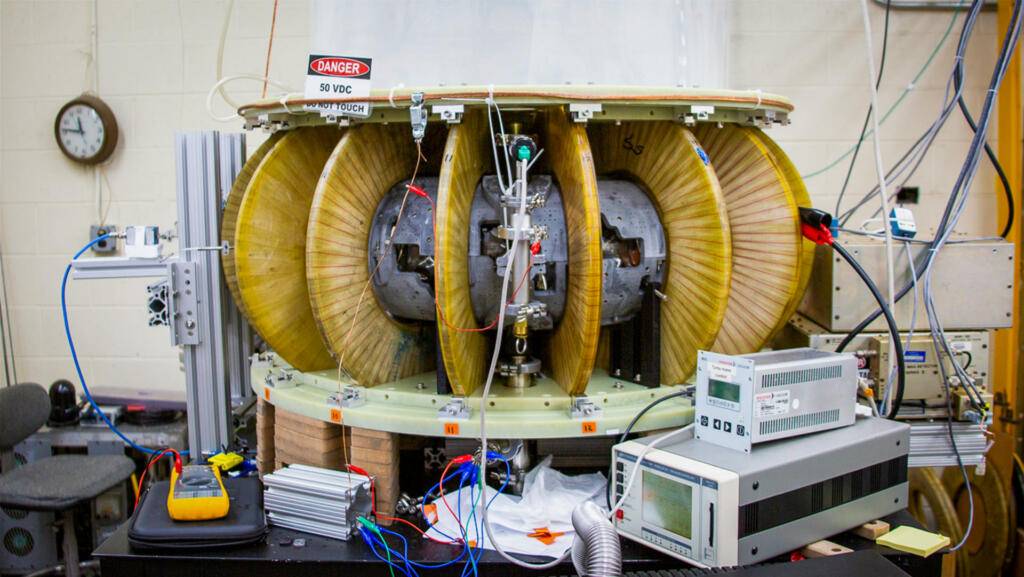
A photo of MUSE, the first stellarator built at PPPL in 50 years and the first ever to use permanent magnets (Photo credit: Michael Livingston / PPPL Communications Department)
LinkedIn Twitter Facebook WhatsApp Pinterest Email Copy Link

The pursuit of energy production free from fossil fuels has gained significant momentum, with innovations in cleaner energy sources accelerating rapidly. One such advancement comes from the field of plasma research, specifically focusing on star generators or stellarators. These devices are crucial for exploring plasma, the fourth state of matter, which is immensely powerful but notoriously unstable. Among the latest developments in this field is MUSE, a new type of stellarator developed by researchers at the Princeton Plasma Physics Laboratory (PPPL), featuring a 3D printed casing and permanent magnets.

MUSE (Magnetized Ultra-Small Stellarator Experiment) is a revolutionary stellarator designed with simplicity and cost-effectiveness in mind. Unlike traditional stellarators that rely on complex electromagnets requiring additional electricity to generate magnetic fields, MUSE uses permanent magnets with simpler geometries. This innovative approach, combined with a 3D printed outer casing, has paved the way for more accessible and affordable studies in nuclear fusion power plants.

Permanent Magnets and 3D Printing: A Cost-Effective Solution Traditional stellarators are expensive to produce due to their reliance on complex electromagnets and intricate structures. However, recent research at PPPL has demonstrated that permanent magnets—akin to those used in refrigerators—can be used to generate magnetic fields under specific conditions. This discovery led to the need for a robust circular structure to support the magnets and withstand magnetic forces, prompting the use of additive manufacturing.

3D printing was key to meeting the unique manufacturing requirements for MUSE’s outer casing. The design flexibility offered by additive manufacturing allowed for a double-curvature bracket with multiple cavities of varying inclinations and radii, accommodating the magnets. Such complex geometries would have been challenging to achieve with conventional manufacturing methods. Throughout the development process, several partial and full-scale prototypes were produced using 3D printing, illustrating its potential for creating intricate designs.

The researchers utilized OpenSCAD software to design MUSE and opted for HP’s Multi Jet Fusion technology to bring their vision to life. This technology’s precision and ability to capture fine details were crucial for the project. The team considered other additive manufacturing methods like selective laser sintering, but concerns about potential distortions during cooling led them to choose Multi Jet Fusion.

Implications for the Future of Stellarators The creation of MUSE represents a significant step forward in stellarator design, offering a more cost-effective and simplified approach. Michael Zarnstorff, a senior research physicist at PPPL, noted that MUSE was primarily built with commercially available parts, underscoring the potential for reducing costs and streamlining production. The use of 3D printing enabled the team to collaborate with various companies and acquire the precise components they needed without producing them in-house.

This innovative approach has the potential to make star generators more affordable and accessible, contributing to further research in nuclear fusion and plasma physics. MUSE’s success demonstrates the transformative power of 3D printing in complex scientific applications, suggesting a promising future for plasma research and cleaner energy production.

Original Source

Subscribe to AM Chronicle Newsletter to stay connected:  https://bit.ly/3fBZ1mP 

Follow us on LinkedIn: https://bit.ly/3IjhrFq 

Visit for more interesting content on additive manufacturing: https://amchronicle.com

3d printing additive manufacturing Energy
Chinmay Saraf
  • Website

Technical Writer, AM Chronicle Chinmay Saraf is a scientific writer living in Indore, India. His academic background is in mechanical engineering, and he has substantial experience in fused deposition-based additive manufacturing. Chinmay possesses an M.Tech. in computer-aided design and computer-aided manufacturing and is enthusiastic about 3D printing, product development, material science, and sustainability. He also has a deep interest in "Frugal Designs" to improve the present technical systems.

NAMIC GLOBAL AM SUMMIT 2025
LATEST FROM AM
Ms. Larissa Smith, Director, Advanced Manufacturing, DRPM, Maritime Industrial Base Program, U.S. Navy, and Mr. Ken Jeanos, VP, Materials and Supply Chain, General Dynamics Electric Boat, are joined by Lincoln Electric leadership and its Additive Solutions team to commemorate the ribbon cutting that marks the investment of four SculptPrint™ 1500 additive manufacturing cells to support the production of critical submarine components. Uncategorized

U.S. Navy’s Maritime Industrial Base Program, General Dynamics Electric Boat, and Lincoln Electric Advance Additive Manufacturing to Strengthen Submarine Production

October 3, 20252 Mins Read
Caracol and RusselSmith Sign a Strategic Partnership to Drive Advanced Manufacturing in West Africa News

Caracol and RusselSmith Sign a Strategic Partnership to Drive Advanced Manufacturing in West Africa

October 3, 20252 Mins Read

Book References

September 20, 20257 Mins Read

CONNECT WITH US

  • 126 A, Dhuruwadi, A. V. Nagvekar Marg, Prabhadevi, Mumbai 400025
  • [email protected]
  • +91 022 24306319
Facebook Instagram YouTube LinkedIn

Newsletter

Subscribe to the AM Chronicle mailer to receive latest tech updates and insights from global industry experts.

SUBSCRIBE NOW

Quick Links

  • News
  • Insights
  • Case Studies
  • AM Training
  • AM Infocast
  • AM Magazine
  • Events

Media

  • Advertise with us
  • Sponsored Articles
  • Media Kit

Events

CNT Expositions & Services
© 2025 CNT Expositions & Services LLP.
  • Privacy Policy
  • Cookie Policy

Type above and press Enter to search. Press Esc to cancel.


0 / 75