


Close Menu
AM ChronicleAM Chronicle
  • Content
    • News
    • Insights
    • Case Studies
    • AM Infocast
  • Focus Regions
    • India
    • Asia Pacific
    • Middle East
    • North America
    • Europe
  • Industries
    • Automotive
    • Aerospace
    • Defence
    • Energy
    • Construction
    • Healthcare
    • Tooling
    • Engineering
  • Training
  • Magazine
    • Digital Issues
  • Events
Facebook Instagram YouTube LinkedIn
  • About us
  • Media Kit
  • Contact us
Facebook Instagram YouTube LinkedIn
AM ChronicleAM Chronicle
  • Content
    1. News
    2. Insights
    3. Case Studies
    4. AM Infocast
    5. View All
    Caracol and RusselSmith Sign a Strategic Partnership to Drive Advanced Manufacturing in West Africa

    Caracol and RusselSmith Sign a Strategic Partnership to Drive Advanced Manufacturing in West Africa

    October 3, 2025
    NAMI and Lockheed Martin Collaborate for Additive Manufacturing Conversion Project

    NAMI and Lockheed Martin Collaborate for Additive Manufacturing Conversion Project 

    September 16, 2025
    LEGO Introduces First Mass-Produced 3D Printed Piece in New Holiday Train Set

    LEGO Introduces First Mass-Produced 3D Printed Piece in New Holiday Train Set

    September 15, 2025
    Boeing Revolutionizes Satellite Production with 3D-Printed Solar Arrays

    Boeing Revolutionizes Satellite Production with 3D-Printed Solar Arrays

    September 15, 2025
    Making Milestones: 3D printing for a greener tomorrow

    Making Milestones: 3D printing for a greener tomorrow

    August 29, 2025
    Nestlé embraces technology and innovation in 3D printing

    Nestlé embraces technology and innovation in 3D printing

    August 29, 2025
    Pure copper and copper alloy (CuCrZr, CuCrNb, CuSn10) samples produced using ADDIREEN's green-laser powder bed fusion AM machines (Image courtesy: Addireen Technologies)

    Addireen: Pioneering Copper Printing in Metal Additive Manufacturing

    August 12, 2025
    Digital Twin Integration in Additive Manufacturing Systems: Revolutionizing Design, Production, and Lifecycle Management

    Digital Twin Integration in Additive Manufacturing Systems: Revolutionizing Design, Production, and Lifecycle Management

    July 4, 2025
    Source: Formlabs

    Case Study: Eaton Corporation’s Strategic Transition to In-House 3D Printing for Tooling Applications

    August 29, 2025
    Revolutionizing Atherosclerosis Research with 3D-Bioprinted Brain Vessels

    Revolutionizing Atherosclerosis Research with 3D-Bioprinted Brain Vessels

    August 25, 2025
    Formlabs fuse 1+

    How Imaginarium Helped Kaash Studio Scale with the Right 3D Printing Technology

    April 12, 2025
    The Formlabs Fuse 1+ 30W

    Kaash Studio Optimized Service Bureau Operations with Formlabs 3D Printers- Case Study

    January 30, 2025
    Sustainable Production of Metal Powder for Additive Manufacturing

    Sustainable Production of Metal Powder for Additive Manufacturing with Bruce Bradshaw

    February 15, 2024
    Meeting Evolving Customer Demands in the Additive Manufacturing Industry with Tyler Reid

    Meeting Evolving Customer Demands in the Additive Manufacturing Industry with Tyler Reid

    February 9, 2024
    Innovation is at the heart of AMUG with Diana Kalisz

    Innovation is at the heart of AMUG with Diana Kalisz

    March 7, 2023
    3D Printing Workshops at AMUG with Edward Graham

    3D Printing Workshops at AMUG with Edward Graham

    March 7, 2023
    Ms. Larissa Smith, Director, Advanced Manufacturing, DRPM, Maritime Industrial Base Program, U.S. Navy, and Mr. Ken Jeanos, VP, Materials and Supply Chain, General Dynamics Electric Boat, are joined by Lincoln Electric leadership and its Additive Solutions team to commemorate the ribbon cutting that marks the investment of four SculptPrint™ 1500 additive manufacturing cells to support the production of critical submarine components.

    U.S. Navy’s Maritime Industrial Base Program, General Dynamics Electric Boat, and Lincoln Electric Advance Additive Manufacturing to Strengthen Submarine Production

    October 3, 2025
    Caracol and RusselSmith Sign a Strategic Partnership to Drive Advanced Manufacturing in West Africa

    Caracol and RusselSmith Sign a Strategic Partnership to Drive Advanced Manufacturing in West Africa

    October 3, 2025

    Book References

    September 20, 2025
    NAMI and Lockheed Martin Collaborate for Additive Manufacturing Conversion Project

    NAMI and Lockheed Martin Collaborate for Additive Manufacturing Conversion Project 

    September 16, 2025
  • Focus Regions
    • India
    • Asia Pacific
    • Middle East
    • North America
    • Europe
  • Industries
    • Automotive
    • Aerospace
    • Defence
    • Energy
    • Construction
    • Healthcare
    • Tooling
    • Engineering
  • Training
  • Magazine
    • Digital Issues
  • Events
Subscribe
AM ChronicleAM Chronicle
Home » News

3D Printing Paves Way for “Designer” Titanium Alloys

News By AM Chronicle EditorJune 2, 20235 Mins Read
3d Printed Titanium Alloy
A collaborative research team has developed a new class of titanium alloys that are strong and ductile rather than brittle. The innovative design combines the use of alloy with 3D-printing processes, potentially revolutionizing applications in sectors like aerospace, biomedical, chemical engineering, space, and energy. These alloys comprise a blend of alpha-titanium and beta-titanium phases, with the added use of oxygen and iron as stabilizers and strengtheners.
LinkedIn Twitter Facebook WhatsApp Pinterest Email Copy Link

Researchers have developed a new class of ductile and strong titanium alloys using a combination of alloy design and 3D printing. The findings, published in Nature, could revolutionize applications in various sectors, including aerospace and energy, and promote sustainability by enabling the production of these alloys from industrial waste and low-grade materials.

A team of researchers has created a new class of titanium alloys that are strong and not brittle under tension, by integrating alloy and 3D-printing process designs.

The breakthrough, published in the top journal Nature, could help extend the applications of titanium alloys, improve sustainability, and drive innovative alloy design.

Their discovery holds promise for a new class of more sustainable high-performance titanium alloys for applications in aerospace, biomedical, chemical engineering, space and energy technologies.

RMIT University and the University of Sydney led the innovation, in collaboration with Hong Kong Polytechnic University and the company Hexagon Manufacturing Intelligence in Melbourne.

Lead researcher Distinguished Professor Ma Qian from RMIT said the team embedded circular economy thinking in their design, creating great promise for producing their new titanium alloys from industrial waste and low-grade materials.

“Reusing waste and low-quality materials has the potential to add economic value and reduce the high carbon footprint of the titanium industry,” said Qian from RMIT’s Centre for Additive Manufacturing in the School of Engineering.
3d Printed Titanium Alloy 02
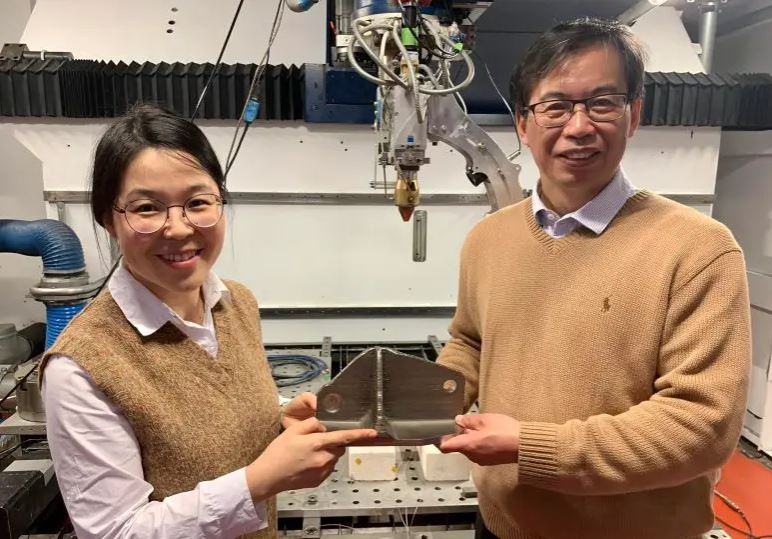
Dr. Tingting Song and Distinguished Professor Ma Qian (left to right) with a titanium alloy created with the laser 3D printer that the team used at RMIT University, Note: this is not an alloy that the team made for this research. Credit: RMIT University

What type of titanium alloys has the team made?

The team’s titanium alloys consist of a mixture of two forms of titanium crystals, called alpha-titanium phase and beta-titanium phase, each corresponding to a specific arrangement of atoms.

This class of alloys has been the backbone of the titanium industry. Since 1954, these alloys have been produced primarily by adding aluminum and vanadium to titanium.

The research team investigated the use of oxygen and iron – two of the most powerful stabilizers and strengtheners of alpha- and beta-titanium phases – which are abundant and inexpensive.

Two challenges have hindered the development of strong and ductile alpha-beta titanium-oxygen-iron alloys through the conventional manufacturing processes, Qian said.

“One challenge is that oxygen – described colloquially as ‘the kryptonite to titanium’ – can make titanium brittle, and the other is that adding iron could lead to serious defects in the form of large patches of beta-titanium.”

The team used Laser Directed Energy Deposition (L-DED), a 3D printing process suitable for making large, complex parts, to print their alloys from metal powder.

“A key enabler for us was the combination of our alloy design concepts with 3D-printing process design, which has identified a range of alloys that are strong, ductile, and easy to print,” Qian said.

The attractive properties of these new alloys that can rival those of commercial alloys are attributed to their microstructure, the team says.

“This research delivers a new titanium alloy system capable of a wide and tunable range of mechanical properties, high manufacturability, enormous potential for emissions reduction, and insights for materials design in kindred systems,” said co-lead researcher University of Sydney Pro-Vice-Chancellor Professor Simon Ringer.

“The critical enabler is the unique distribution of oxygen and iron atoms within and between the alpha-titanium and beta-titanium phases.

“We’ve engineered a nanoscale gradient of oxygen in the alpha-titanium phase, featuring high-oxygen segments that are strong, and low-oxygen segments that are ductile allowing us to exert control over the local atomic bonding and so mitigate the potential for embrittlement.”

What are the potential applications of the research findings?

Lead author Dr. Tingting Song, RMIT Vice-Chancellor’s Research Fellow, said the team is “at the start of a major journey, from the proof of our new concepts here, towards industrial applications”.

“There are grounds to be excited – 3D printing offers a fundamentally different way of making novel alloys and has distinct advantages over traditional approaches,” she said.

“There’s a potential opportunity for industry to reuse waste sponge titanium-oxygen-iron alloy, ‘out-of-spec’ recycled high-oxygen titanium powders or titanium powders made from high-oxygen scrap titanium using our approach.”

Co-lead author Dr. Zibin Chen, who joined Hong Kong Polytechnic University from the University of Sydney in the later stages of the collaboration, said the research had broader implications.

“Oxygen embrittlement is a major metallurgical challenge not only for titanium, but also for other important metals such as zirconium, niobium, and molybdenum and their alloys,” he said.

“Our work may provide a template to mitigate these oxygen embrittlement issues through 3D printing and microstructure design.”

Support for this research

The team’s work benefited from sustained, targeted investment in research infrastructure from national and state governments and from universities, Professor Ringer said.

“In many ways, this work showcases the power of Australia’s national collaborative research infrastructure strategy and sets the scene for extending this strategy into the realm of advanced manufacturing,” he said.

References:

“Strong and ductile titanium-oxygen-iron alloys by additive manufacturing” 31 May 2023, Nature.
DOI: 10.1038/s41586-023-05952-6

“Designer titanium alloys created using 3D printing” 31 May 2023, Nature.
DOI: 10.1038/d41586-023-01360-y

The Australia Research Council (ARC) through the Discovery Program and the Training Centre in Surface Engineering for Advanced Materials (SEAM) funded and supported this research.

The team acknowledges support from the Australia–US Multidisciplinary University Research Initiative program supported by the Australian Government; The Hong Kong Polytechnic University; the State Key Laboratories in Hong Kong from the Innovation and Technology Commission of the Government; and Hexagon Manufacturing Intelligence for its Simufact DED solution used in the L-DED process design.

Subscribe to AM Chronicle Newsletter to stay connected:  https://bit.ly/3fBZ1mP 

Follow us on LinkedIn: https://bit.ly/3IjhrFq 

Visit for more interesting content on additive manufacturing: https://amchronicle.com

Original Source

3d printing additive manufacturing Aerospace Energy Metal 3D Printing Nature Titanium
AM Chronicle Editor

NAMIC GLOBAL AM SUMMIT 2025
LATEST FROM AM
Ms. Larissa Smith, Director, Advanced Manufacturing, DRPM, Maritime Industrial Base Program, U.S. Navy, and Mr. Ken Jeanos, VP, Materials and Supply Chain, General Dynamics Electric Boat, are joined by Lincoln Electric leadership and its Additive Solutions team to commemorate the ribbon cutting that marks the investment of four SculptPrint™ 1500 additive manufacturing cells to support the production of critical submarine components. Uncategorized

U.S. Navy’s Maritime Industrial Base Program, General Dynamics Electric Boat, and Lincoln Electric Advance Additive Manufacturing to Strengthen Submarine Production

October 3, 20252 Mins Read
Caracol and RusselSmith Sign a Strategic Partnership to Drive Advanced Manufacturing in West Africa News

Caracol and RusselSmith Sign a Strategic Partnership to Drive Advanced Manufacturing in West Africa

October 3, 20252 Mins Read

Book References

September 20, 20257 Mins Read

CONNECT WITH US

  • 126 A, Dhuruwadi, A. V. Nagvekar Marg, Prabhadevi, Mumbai 400025
  • [email protected]
  • +91 022 24306319
Facebook Instagram YouTube LinkedIn

Newsletter

Subscribe to the AM Chronicle mailer to receive latest tech updates and insights from global industry experts.

SUBSCRIBE NOW

Quick Links

  • News
  • Insights
  • Case Studies
  • AM Training
  • AM Infocast
  • AM Magazine
  • Events

Media

  • Advertise with us
  • Sponsored Articles
  • Media Kit

Events

CNT Expositions & Services
© 2025 CNT Expositions & Services LLP.
  • Privacy Policy
  • Cookie Policy

Type above and press Enter to search. Press Esc to cancel.


0 / 75