

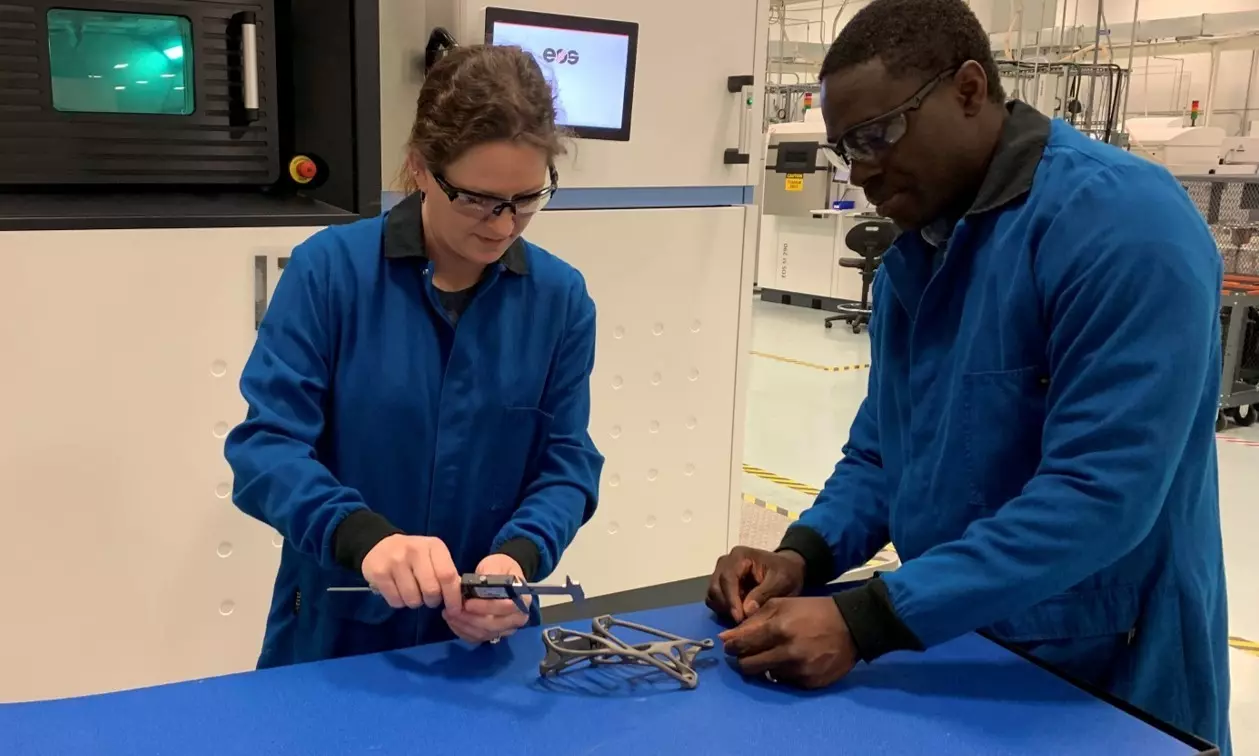
3D-printing technologies have evolved from a means to produce tools and prototypes rapidly at a lower cost to a way of solving complex engineering design problems. Increased design freedom associated with 3D printing has enabled manufacturers to create differentiated products with greater functionality and enhanced durability, all while reducing cost and lead time.
Highlights
- 3D-printing technologies have evolved from a means to produce tools and prototypes rapidly at a lower cost to a way of solving complex engineering design problems.
- 3D printing – also known as additive manufacturing – offers a way to reduce the environmental impact of manufacturing and develop more sustainable products.
- Expanding the use of 3D printing in aerospace and other industries will help lessen the environmental impact of manufacturing.
Now, 3D printing – also known as additive manufacturing – offers a way to reduce the environmental impact of manufacturing and develop more sustainable products. Manufacturing accounts for 12% of the world’s global greenhouse gas emissions, according to The Center for Climate and Energy Solutions.
3D printing can be more sustainable than standard manufacturing technologies because it involves less material, fewer machining operations and creates smaller amounts of scrap. Its lighter and often more geometrically flexible designs make environmentally-sound product innovations possible in industries ranging from aerospace to medical devices to sporting goods.
Sustainable manufacturing
To understand the extent of the positive effect that additive manufacturing can have on the carbon footprint of manufacturing, consider the millions of parts in an aeroplane. At Boeing, we conduct life cycle assessments to quantify the impact that our aircraft have on the environment from the moment materials are mined to part fabrication to when an aircraft is retired from service.
When 3D printing was used to produce over one thousand brackets in the galleys of our 787 Dreamliners, we found we could cut the carbon emissions, waste to landfills and hazardous materials, water and energy used for these parts by between 30 and 39%. Instead of creating the bracket from a large metal block and machining away excess material, we created the part by feeding titanium wire into a plasma field that efficiently melted and layered the material, creating a solid form. The speedier and more material-efficient process decreased the water, material and energy consumed, while reducing excess material waste and lubricants used in standard machining processes.
In a different example, we lessened the carbon footprint associated with manufacturing and assembling a satellite’s payload by consolidating tens of thousands of components. We eliminated thousands of secondary fasteners that otherwise join individual components by printing them as one piece. We also removed other features, such as welds and brazes prone to failure with an additive manufacturing process called powder bed laser fusion.
With this technology, a laser beam irradiates successive layers of powder thinner than a human hair, one layer at a time to make a three-dimensional object. Each layer corresponds to the geometry of a ‘sliced’ computer model of the part to be printed, where the slices in the model are the same thickness as the printing layer thickness. The laser melts the powder, causing the powder particulates to blend together before they rapidly solidify into a solid form. A new layer of powder is then applied, repeating the process until the part is made.
This 3D-printing approach not only lowered the carbon emissions and waste from manufacturing the components that comprise many critical aspects of the satellite. It also eliminated the carbon emissions involved with fabricating, warehousing, transporting, inspecting, testing and assembling the secondary fasteners that were no longer used.
Sustainable products
Thanks to its more flexible geometric design capability and reduction of material waste, additive manufacturing is inspiring environmentally sustainable product innovations. In aerospace, 3D printing makes it possible to build lighter and more fuel-efficient aircraft.
For example, we reduced the weight of a complex fire detector bracket flown on our Boeing EcoDemonstrator aeroplane used to develop and test new technologies by 31% by optimising the bracket’s design and printing it with laser powder bed fusion. The new optimised 3D-printing design enabled us to make a lightweight component that would be impossible to manufacture with traditional means.
Since the traditional manufacturing process for this part relied on sheet metal and did not require significant material or machining resources, the carbon footprint from using 3D printing for manufacturing was slightly higher than standard manufacturing processes. But the lighter 3D-printed part lowered the fuel burn and carbon emissions of the aircraft over its lifetime in service by 19%, far outweighing the small increase of carbon emissions during 3D printing.
With 3D printing, defect-prone welds were also eliminated along with the quality issues. The previous traditional manufacturing processes for the part included sheet rolling, laser cutting and joining metal with welds in 12 places, often resulting in quality issues that needed to be corrected.
A more sustainable industrial age through 3D printing
To be sure, additive manufacturing does not always decrease the environmental impact in the manufacturing plant. Companies must evaluate the value of introducing 3D printing, especially when converting components that do not traditionally require significant material and machining resources. Efforts to incorporate design changes now possible with 3D printing that add value and lead to greener operations during part service, such as weight reduction or increased durability, quality and performance, should be undertaken and incorporated.
We are just beginning to tap the full potential of 3D-printing technologies for a greener and cleaner manufacturing era. It’s already clear that additive manufacturing is critical for the future of more sustainable flight. Aircraft will become even lighter in weight, more streamlined and fuel-efficient as we use 3D printing to create parts that conform to oddly shaped cavities within an aeroplane. And, new and recycled materials will be introduced that require fewer environmental resources to recycle.
Expanding the use of 3D printing in aerospace and other industries will help lessen the environmental impact of manufacturing. Given the urgent need to reduce greenhouse gas emissions in our efforts to mitigate the climate challenges ahead, introducing additive manufacturing into our processes will lead to a greener means of developing sustainable innovations and products.
Subscribe to AM Chronicle Newsletter to stay connected: https://bit.ly/3fBZ1mP
Follow us on LinkedIn: https://bit.ly/3IjhrFq
Visit for more interesting content on additive manufacturing: https://amchronicle.com