

This article has been republished from the article written by Laura Kastenmayer on 3D Printing with Amorphous Metals for SME.
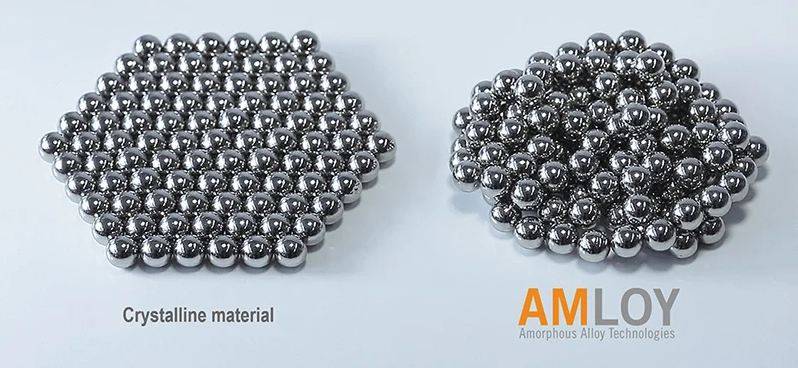
Amorphous metals are versatile because they have exceptional properties. They are extraordinarily hard, yet also highly elastic. That ought to be a contradiction, but not with materials like these. Amorphous metals, or metallic glasses, have a disordered inner structure. This is because they are cooled rapidly from the molten state, which prevents the formation of an orderly, crystalline structure. The result is an amorphous, noncrystalline solid, in which the atoms remain in a largely disordered state.
In addition to outstanding strength and elasticity, amorphous metals’ unusual structure also makes them resistant to corrosion and wear. They are perfect for medical applications such as hard-wearing scalpels and minimally invasive surgical instruments. In the future, they will also be used to fabricate implants for use within the human body. When subjected to pressure and tension, they behave almost like human bone, with which they share a similar modulus of elasticity. This means they are less rigid than other materials and therefore better able to accommodate the loads that bones have to bear.
These new materials are also ideal for implants. They are just as biocompatible as the current material of choice, titanium or its alloy Ti6Al4V. The human body has a high tolerability to implants made of amorphous metals.
New Alloys From Additive Manufacturing
Heraeus Amloy is currently working on new alloys for use in the fabrication of medical implants. “Zirconium-based alloys are suitable for medical applications,” said Eugen Milke, innovation manager at Heraeus Amloy. “We already have a biocompatible zirconium alloy—Amloy-ZR02—which is certified according to ISO 10993-5 and ISO 10993-12.”
According to Milke, there is also demand for titanium alloys in the medical sector: “Titanium is a proven material for medical components such as bone implants and artificial pacemakers, so we’re also working on titanium alloys right now.”
The development team is using an additive manufacturing process to produce the actual components. Heraeus Amloy has specially modified the composition of Amloy-ZR02 for this purpose. In a joint project with laser specialists from TRUMPF, the company is investigating the use of the TruPrint 2000 3D printer to industrially produce components made of amorphous metals.
Innovative Process Meets Innovative Material
The 3D printer and the new lightweight materials make for a perfect team. The laser creates structures only where these are required in order to fabricate the part. This saves material and weight, even in the case of large and complex components. The process has only a low heat input, which is a key requirement for production with amorphous metals. With a diameter of a mere 55 μm, the laser beam creates only a small melt pool. Heat is therefore quickly dissipated, ensuring that the critical cooling rate of 200 kelvins per second is observed. This prevents the molten metal from crystallizing. The narrow beam focus also enables the production of complex structures with a high surface quality and degree of detail.
Klaus Parey, managing director at TRUMPF Additive Manufacturing, is confident: “Amorphous metals offer big potential for numerous industries. They are especially suitable for applications in medical engineering, which is one of the most important sectors for additive manufacturing. We therefore believe that this collaboration is a great opportunity for us and our industrial 3D printers to make further inroads in this key market.” Jürgen Wachter, head of Heraeus Amloy, agreed: “This combination of innovative materials and additive manufacturing has the potential to revolutionize medical practice. Working in close collaboration with clinics, it will be possible to use 3D printers to produce implants that are precisely tailored to individual patients.”
Implants From the 3D Printer
In order to realize this vision, the two partners have signed up to a research project at the Medical University of Graz. Launched in October 2019, Clinical Additive Manufacturing for Medical Applications (CAMed) is funded by the Austrian Federal Ministry for Climate Action, Environment, Energy, Mobility, Innovation and Technology (BMK), the Austrian Federal Ministry for Digital and Economic Affairs (BMDW) and by the Steierische Wirtschaftsförderungsgesellschaft (SFG), the business development agency of the Austrian federal state of Styria. CAMed is investigating the full process chain for the additive manufacture of implants customized to individual patients. Alongside areas such as computer modeling, data processing and various finishing processes, the project is also focusing on new materials and production methods.
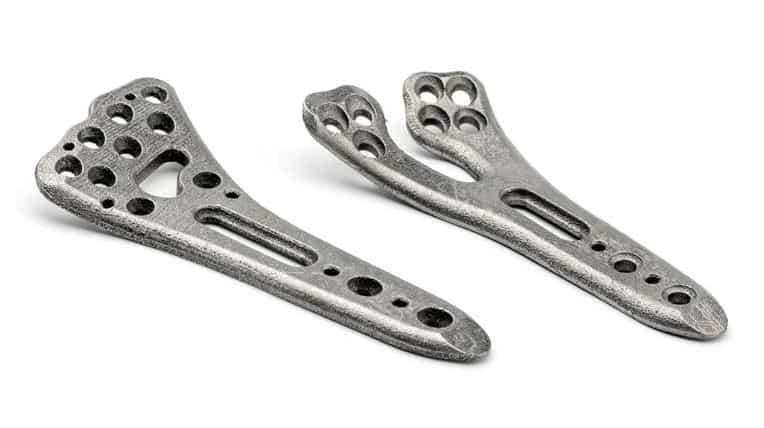
Specifically, this means using 3D printers to produce rib implants and customized plate implants for treating physical injuries. There is huge potential here, particularly in the case of complex bone fractures. With the implants currently on the market—for example, radius plate implants or other implants for trauma surgery—big compromises are often required. For a start, there are only a few basic sizes of implant available. For lesions from physical injury or following a tumor, improvisation is therefore needed. This means the surgeon has to bend the metal implant by hand until it has the right shape and then fix it to the bone with screws. Sometimes, this remains firmly attached; sometimes less so. This is because an implant is subject to constant strain. A rib implant, for example, has to complete around eight million respirations a year. This often results in a stress fracture or a loosening of the fixture to the breastbone, therefore necessitating a further intervention. At present, there is no alternative.
Moreover, in order to encourage the healing process after surgery, the bone with the implant has to be stabilized but also requires regular movement. This is the case with the plate implant used to fix the humerus, the bone in the upper arm, where conventional implants rapidly encounter their limits.
By contrast, 3D printing can deliver customized implants made of amorphous materials that have the needed strength but are also flexible enough to withstand and cushion the necessary movement. At the same time, the additive manufacturing process can also create a porous surface texture that encourages the bone tissue to take root in the implant. If a smooth surface is required, so as to facilitate the later removal of the implant, this method can also produce a surface quality of one micrometer without the need for any finishing. That is better than most other materials. Furthermore, should an even smoother surface be required, a surface roughness of as little as Ra 0.05–0.08 μm can be achieved with a milling machine.
Almost Like Human Bone
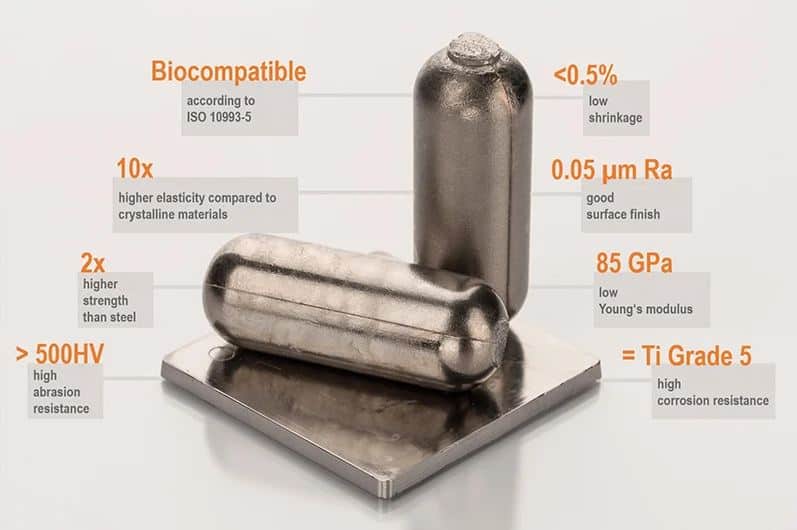
As part of the CAMed project, Heraeus is currently testing the alloy AMLOY-ZR02. This comprises 65 percent zirconium, 16 percent copper, 12 percent nickel, 4 percent aluminum and 3 percent titanium. With a density of 6.6 g/cm³, this new alloy is heavier than the titanium alloys conventionally used in medical implants. However, the design freedom offered by the use of an additive manufacturing process means that less material is required, thereby enabling weight savings of as much as 20 percent. Similarly, a flexural strength of 2,000 MPa and a tensile strength of 1,700 MPa mean that implants can be made thinner than usual. Moreover, with a modulus of elasticity of 85 GPa, it is closer to human bone (17–21 GPa) than is titanium. If the aim is a combination of flexibility and strength, then the new AMLOY alloy is ideal for fabricating plate implants, as these can then be made thinner than is possible with titanium. This also encourages the healing process.
Completely New Applications
Initial results from the CAMed project are highly promising. As such, additively manufactured implants, adapted to the individual patient and possessing outstanding material properties, are now a very real prospect. Other applications such as prosthetic implants and heart valves are also a possibility. With their exceptional properties, amorphous metals are extremely versatile and will enable numerous new applications, not least in the field of medical engineering.